English
 Español
Categories
Contacts
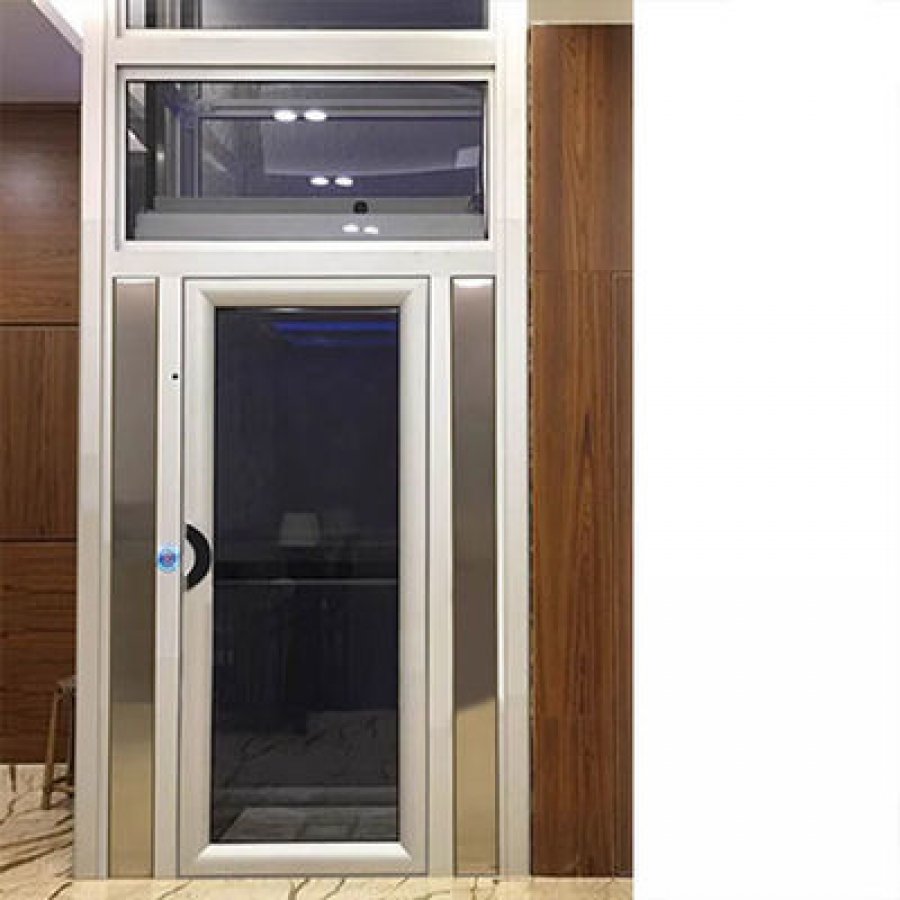
Microprocessor-Controlled Hydraulic Home Elevator with Emergency Stop
Product Details:
Brand Name
YIMEISITE
Place of Origin
China
Certification
ISO 9001
Payment & Shipping Terms:
Minimum Order Quantity
1 Set
Price
USD 4,000-10,000 per set
Packaging Details
Export Non-Fumigation Wood Box
Delivery Time
45 Days
Payment Terms
TT or LC at sight
Supply Ability
10 Sets Per Month
| Safety Features: | Emergency Stop Button | Power: | 220V, 50Hz, Single Phase |
| Warranty: | 1 Year | Motor: | 2.2 Kw |
| Power Supply: | Single-phase AC | Door Type: | Automatic |
| Control System: | Microprocessor | Max Height: | 14.5 M |
| Highlight: | Microprocessor Controlled Hydraulic Home Elevators,Emergency Stop Button Hydraulic Home Elevators,Microprocessor Controlled Home Elevators | ||
Product Description
Microprocessor-controlled hydraulic home elevator - published specification
A microprocessor controlled hydraulic home elevator is a hydraulic home lift whose travel is managed by an electronic controller rather than by a relay panel. The published envelope on this page is 14.5 m of travel over up to five stops, a 0 m pit, 3 m of clear headroom at the top landing, 2.9 m cylinders and a 2.2 kW power unit on a 220 V single-phase supply. The car is finished in 304 stainless steel or aluminium alloy with automatic doors, the safety set includes an emergency stop button, and the machine is published with a one-year warranty.
The reason to specify this arrangement instead of a plain hydraulic lift is the controller. It decides how the car arrives at a floor, how the ride starts and stops, and what the lift tells you when something is wrong. Those three questions are what sections 1 and 2 deal with, and section 3 lists every figure this page publishes together with where each figure comes from.
- 2.2kW power unit on a 220 V single-phase supply
- 14.5metres of published travel
- 0stops served at the published travel
- 0pit depth - nothing excavated below the lowest floor
- 0metres of clear headroom at the top landing
Read this firstTwo sections decide most projects. Section 1 sorts your house into "fits as drawn", "fits once one item is settled" or "use a different machine". Section 2 explains what the controller changes on the ride, because that is the whole case for paying for it.
1. Is this lift right for your house?
This is the version of a home lift that removes the pit. The drive stands at the lowest landing instead of in a machine room above, and the published pit depth is 0 m, so nothing is dug below the finished floor. On a house that is already built and furnished, that single line decides whether the project is a small building job or a major one.
What the machine asks for instead is a sound floor at the bottom of the run and clear height at the top. The published headroom at the top landing is 3 m, and the published travel is 14.5 m over up to five stops. A surveyor can measure both in one visit. Neither of them is a reason to abandon a house, but both of them are cheaper to check before anything is ordered.
Three questions sort most houses
Where can the car travel without cutting a floor that matters? Can the floor at the lowest landing carry the machine, because on a pitless hydraulic lift the walking level is also the machine base? Can the top landing give the published 3 m of clear height? The answers place your project in one of the three groups below.
StraightforwardThe lift fits as drawn
- A clear route exists for the car to travel between the landings, with the shaft or enclosure kept square over the full run.
- The floor at the lowest landing is solid - a ground slab or an existing terrace - and the published 0 m pit means the finished level stays as it is.
- The travel stays inside the published 14.5 m, the stop count stays at five or fewer, and the top landing has the published 3 m of clear height.
- A 220 V single-phase supply can reach the machine position, which is the supply this page publishes.
ConditionalThe lift fits after one item is settled
- A suspended slab over a basement or a void would carry the machine, so the point loads need a structural check before the position is fixed.
- A terrace or a first-floor deck at the lowest landing has to be prepared so the finished surface meets the machine position cleanly.
- Where the house is finished and furnished, the parts have to reach the position through an opening that may need temporary protection.
- A top landing close to the published 3 m needs a survey that confirms the clear height over the whole landing rather than at one point.
Wrong answerUse a different machine
- A project that needs more than the published five stops, or more than the published 14.5 m of travel, is outside this model. Those figures are a limit rather than a starting point.
- A building with nowhere to give the published 3 m of clear headroom at the top landing needs a different arrangement.
- Where a project needs a rated load, a running speed or a fire performance this page does not publish, this page cannot answer it. Those figures are not stated here and must not be assumed.
The fastest way to move a project forward is to send three things: the floor-to-floor heights, the clear height at the top stop, and a photograph of the floor the machine would stand on. Those three answer the travel, headroom and base questions before anybody visits the site, and the full list is in section 11.
2. What the microprocessor control changes
Hydraulic drive is old technology and it works. Oil pressure lifts the car, the same pressure holds it, and the machine is quiet and simple. What a plain hydraulic lift does not do well is the part at the end of the trip, when the car has to meet the floor and stop there. That is the part a microprocessor controller takes over.
The controller on this model is published as a microprocessor system. It reads the position of the car and the state of the drive continuously, then manages the valve and the motor against what it reads. Three visible differences follow, and they are the ones a buyer notices on the first ride.
Levelling: the car meets the floor instead of hunting for it
On a hydraulic lift the car sits on a column of oil. Oil warms as the lift works, the load changes when somebody steps in or out, and the car drifts a little against the landing. A relay panel cannot do much about that, so it stops the car somewhere near the floor and lets a mechanical arrangement take up the difference.
A controller that reads position can slow the car earlier, hold it, and correct the last part of the approach. That is what people mean by a smooth levelling home elevator. The published page does not state a levelling tolerance in millimetres, so no figure is quoted here; if the tolerance matters to your project, ask for it in writing and it will be confirmed against the specification for your machine.
Starting and stopping: the ride has a beginning and an end
The second difference is felt rather than measured. A hydraulic lift on simple control starts at full effort and stops when the power is cut, which gives a jolt at each end of the trip. A controller ramps the motor and the valve, so the car accelerates into the run and decelerates out of it.
On a domestic lift this matters more than it sounds. A home lift carries children, grandparents and shopping, and it stops at floors where people are standing. Ramp control is the difference between a lift that is used casually and one that people brace themselves for. This page publishes the controller as microprocessor based and the motor as 2.2 kW; it does not publish an acceleration curve, and none is invented here.
Self-check: the lift reports instead of failing quietly
The third difference is what happens when something is wrong. A relay panel has no way to describe a fault. It stops, and somebody has to work out why. A controller that monitors the drive can hold a fault code, refuse to start, and hand the question to a technician with a starting point.
What a code buys you is time. A lift that will not move is a household problem, and every hour spent guessing is an hour the lift is out of use. The published page names the controller but does not list the codes, so the code list for this model has to come from the supplier with the machine. Treat it as a document to ask for, not something to infer.
The same drive, two control philosophies
Buyers often compare two lifts that turn out to have identical hydraulics and different control panels. Use the switch below to see where the difference lands. Neither column is a claim about quality; they are two ways of running the same kind of drive, and the published figures on this page belong to the second one.
Relay panel older approach
- Levelling - the car stops near the landing and the last part of the approach is left to the fixed setting of the valve. Load and oil temperature change during the day, and the car can sit slightly out of line with the floor.
- Starting and stopping - the motor and the valve are switched on and off. The car begins to move and stops with the drive, so the ends of the trip are abrupt.
- Faults - a relay panel can stop the lift but cannot describe what stopped it. The technician works from the symptom.
Microprocessor panel this page
- Levelling - the panel reads car position and closes the drive on that reading, so the car meets the floor rather than drifting past it. The published page carries no tolerance figure, so ask for one.
- Starting and stopping - the panel ramps the motor and the valve in both directions. The ride gets a beginning and an end instead of a switch.
- Faults - the panel can hold a code and refuse to start, which gives a technician a starting point and the household an answer.
Three items are worth asking for in writing when you compare two quotations for the same hydraulic drive. None of them appears in a photograph of the finished lift, and all three change the ride.
- The levelling tolerance the supplier will guarantee, in millimetres, for your machine.
- The fault code list the controller holds, so that a stopped lift has an answer.
- What the panel does when it refuses to start, and how the lift is reset afterwards.
If your project has two quotations that look almost identical, compare the control panel before you compare anything else. On a hydraulic home lift the hydraulics are the commodity and the controller is where the ride is decided.
3. The specification this page publishes
Everything below comes from this page rather than from a brochure for a similar machine. Two sources are used. The parameter table that sits beside the product photograph carries the brand, the origin, the certification and the ordering terms. The specification block further down the product page, together with the description that used to sit under it, carries the technical figures. Where the two agree, a row names both.
The table is the short version of this page. If a figure you need is not in it, the page does not publish that figure, and no number has been filled in to make the table look complete.
| Item | Published value | Where it is published |
|---|---|---|
| Lift type | Pitless hydraulic home elevator | Product description on this page |
| Control system | Microprocessor based | Specification block on this page |
| Motor power | 2.2 kW3 hp (2.2 kW) | Specification block on this page |
| Power supply | 220 V, 50 Hz, single phase AC | Specification block and parameter table |
| Maximum travel height | 14.5 m47 ft 7 in (14.5 m) | Specification block on this page |
| Stops served | Up to 5 | Product description on this page |
| Pit depth | 0 m0 in (0 m) | Specification block on this page |
| Overhead clearance at the top landing | 3 m9 ft 10 in (3 m) | Specification block on this page |
| Cylinders | 2.9 m long, mounted at the lowest landing9 ft 6 in long, mounted at the lowest landing | Specification block on this page |
| Door type | Automatic | Specification block on this page |
| Cabin material | 304 stainless steel or aluminium alloy | Product description on this page |
| Safety features | Emergency stop button, hydraulic safety | Specification block on this page |
| Warranty | 1 year | Parameter table and specification block |
| Certification | ISO 9001 | Parameter table beside the product photograph |
The certification named in the parameter table is a quality management certification. It describes how the product is made and audited, not how one machine performs on your site. This page publishes no product level certification, no fire rating and no seismic qualification, and nothing on this page claims any of them. If your building department needs one of those, raise it at enquiry and it will be answered for your destination.
Two of the rows above are the ones that decide most projects. The 0 m pit is why this machine suits finished houses, and the 3 m of clear headroom is the dimension that most often fails a survey. Both are covered in section 5. For the wider range, the hydraulic home elevator range collects the models that share this drive.
Ordering terms, and where the price sits
The commercial terms published on this page are listed below, and the price band sits in the parameter table beside the product photograph rather than in this article. That is deliberate. A price for a made-to-order lift depends on the travel, the stop count, the finish and the destination, and a second set of numbers printed here would be a second version of the truth.
Minimum order quantity
One set. The published machine is built to order from the drawing approved for your building rather than picked from stock.
Packaging
Export non-fumigation wood box, as published. The cabin, the guide sections and the hydraulic assembly travel as separate items and are assembled on site.
Delivery time
45 days as published, counted from the approved drawing and the confirmed order rather than from the first enquiry.
Payment terms
TT or LC at sight, as published. Confirm what your bank needs before the order is placed, because the terms are fixed with the order.
Supply ability
10 sets per month as published. A project with a fixed handover date should say so early, because the slot is taken when the order is confirmed.
Price band
Printed in the parameter table beside the product photograph on this page, with the currency and the unit. Ask for a firm figure against your travel, stops and finish.
4. Supply and electrical: the 220 V question
This machine is published with a 220 V, 50 Hz, single phase supply and a 2.2 kW power unit. That single line removes one of the obstacles that stops home lift projects before they start. A traction lift usually wants a three-phase supply and a machine room to put the equipment in; this one does not, so a house with an ordinary domestic installation can carry it.
What the line does not remove is the work between your consumer unit and the machine. The lift needs its own circuit, a protective device chosen for the machine, a route for the cable and a means of isolating the lift. None of that is difficult, and all of it is cheaper to plan before the floor and the walls are closed.
What the published supply gives you
Published220 V single phase
The machine is built for a domestic supply rather than a three-phase service. In most houses the lift becomes an additional circuit rather than a new service.
Published2.2 kW power unit
The published motor rating is the starting point for the electrician who sizes the circuit and the protective device for your installation.
Published50 Hz
The published machine runs at 50 Hz. If your site runs at 60 Hz, or your supply is not 220 V, say so at enquiry so the machine matches the site.
What the site still has to provide
To settleA dedicated circuit
The lift should not share a circuit with the rest of the house. Your electrician decides the cable size and the protective device from the published rating and the cable run.
To settleA cable route
A route from the consumer unit to the machine position, with the lift isolated at a point a technician can reach. Decide it while the walls are still open.
To settleAn isolator at the machine
The published specification does not describe the isolating arrangement. Ask for it in writing, then place it where a service call can reach it without moving furniture.
To settleLocal rules
Your destination may require the final connection to be made by a licensed electrician, and may require the lift to be inspected afterwards. Check that before the machine ships.
One line to keep separate in your head: the published supply tells you what the machine is built for, and it can be relied on. The site installation tells you what your electrician has to provide, and it varies with the house. Send the first, ask about the second, and the two do not get confused.
A sister page on this site publishes the same single-phase arrangement on a different hydraulic home lift, so the two can be compared side by side: the single-phase automatic hydraulic home elevator.
5. Installation conditions: 0 m pit and 3 m of headroom
A pitless hydraulic home elevator moves the demand from below the floor to above the car. There is no pit to dig, which is the reason this machine turns up in finished houses. In exchange, the building has to give a sound floor at the machine position and enough clear height at the top landing. Two dimensions, and both of them are measurable in an afternoon.
The published numbers are 0 m of pit and 3 m of clear headroom at the top landing, over a published travel of 14.5 m and up to five stops. Work through the five checks below before you book a survey. If all five pass, the visit is a confirmation rather than a discovery.
Four ways a pitless job goes wrong after the order
- Headroom measured at the finished floor of the wrong level. The 3 m is measured at the top landing, not at the bottom of the run.
- A terrace or deck treated as a floor without a structural check. The machine stands on it, so the point loads are real loads.
- A shaft drawn square and built slightly out. The enclosure has to be plumb and square over the whole travel, so it is worth checking after the frame goes up and before the car arrives.
- No route planned for the largest part. The hydraulic assembly and the guide sections are not carried through a standard door frame without thought.
This is the section to send with photographs. A picture of the top landing with a tape measure in it answers the headroom question faster than three paragraphs of description, and a picture of the floor answers the base question the same way.
A second page on this site publishes the same pitless arrangement with the emergency stop named in its title. That one is useful if you are comparing two suppliers against the same brief: the 14.5 m pitless hydraulic home elevator with emergency stop.
6. Car, doors and finish
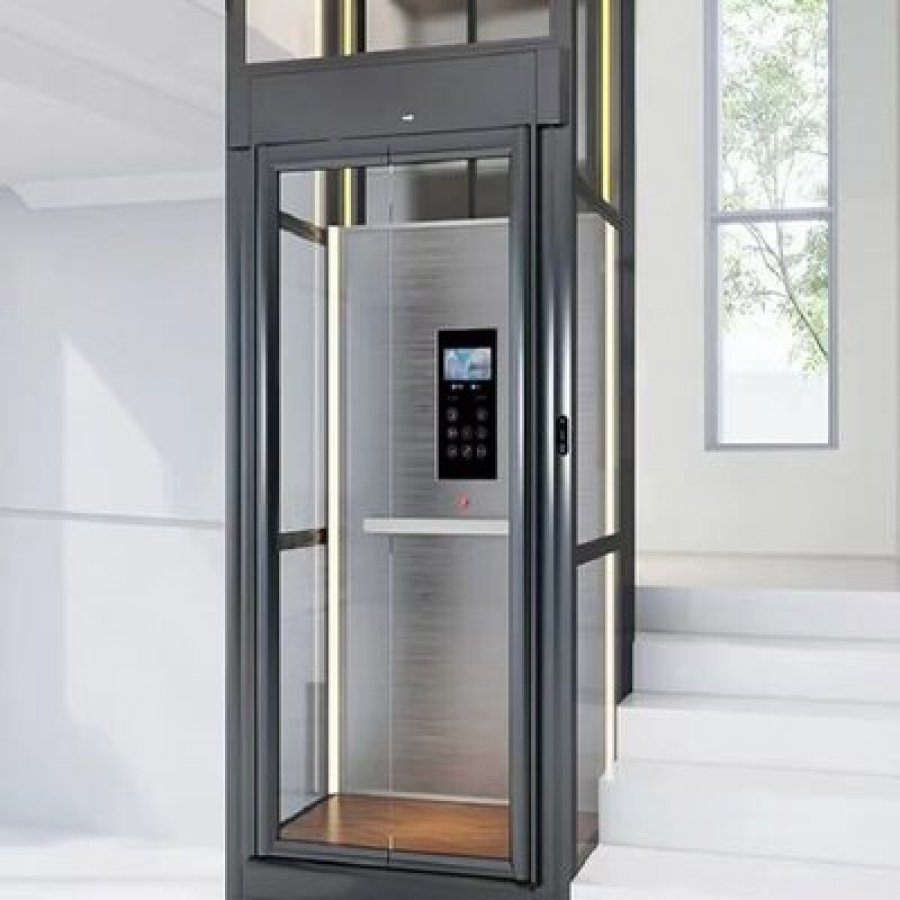
The car is the part of a home lift that everybody actually touches, and on this model the published choice is narrow and clear. The cabin is finished in 304 stainless steel or aluminium alloy, and the doors are published as automatic. Everything else about the appearance of the car follows from those two decisions.
That narrowness is a feature rather than a limitation. A home lift lives inside a house, and the finishes that survive twenty years of use are the ones that can be wiped. Both published materials are hard wearing and both are standard industrial finishes, so a local supplier can repair or replace a panel later.
304 stainless steel cabin
Published as one of the two cabin materials. A stainless car reads as clean and technical, takes a wipe, and stands up to a house with pets or small children. Marks show more easily than on a matt finish, which is a taste decision rather than a defect.
Aluminium alloy cabin
Published as the other cabin material. Aluminium keeps the weight of the car itself down, which matters on a machine that also has to be carried into the building in sections. It suits a lighter, brighter interior.
Automatic doors
Published as automatic. The doors open without the passenger handling the leaf, which is what makes a home lift usable with shopping, a walking frame or a pushchair.
What the page does not publish
The page does not publish a cabin size, a clear door opening or a choice of interior trim. Those have to be confirmed against the drawing for your project rather than assumed from this article.
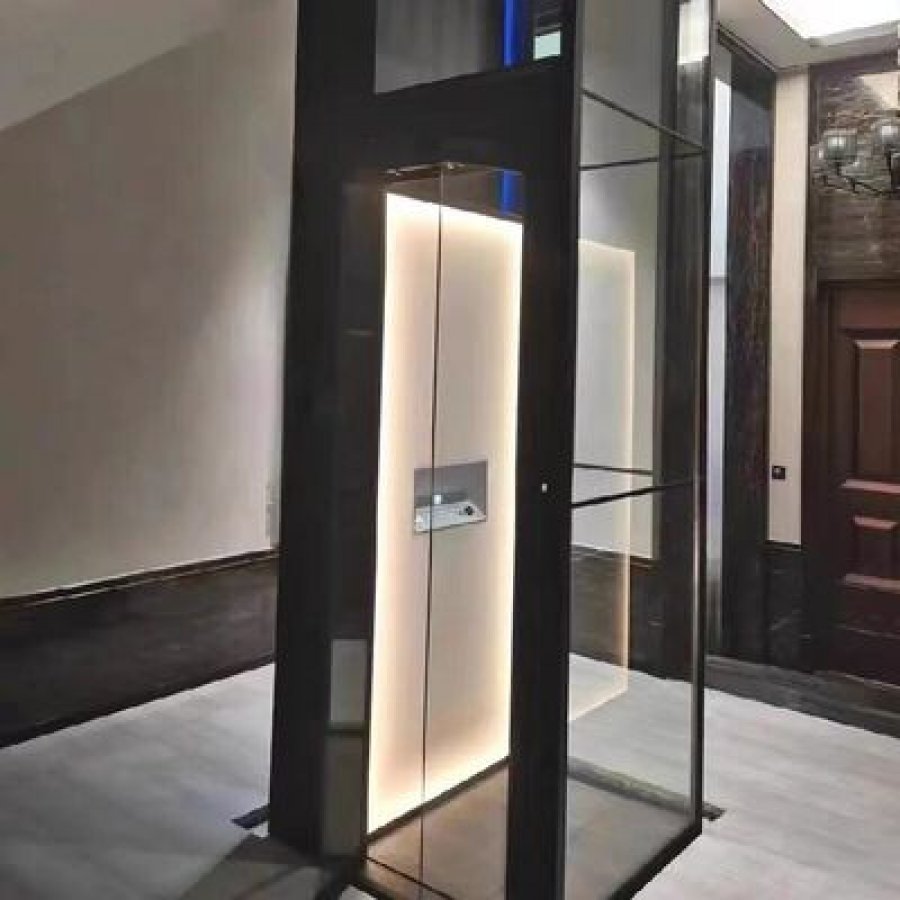
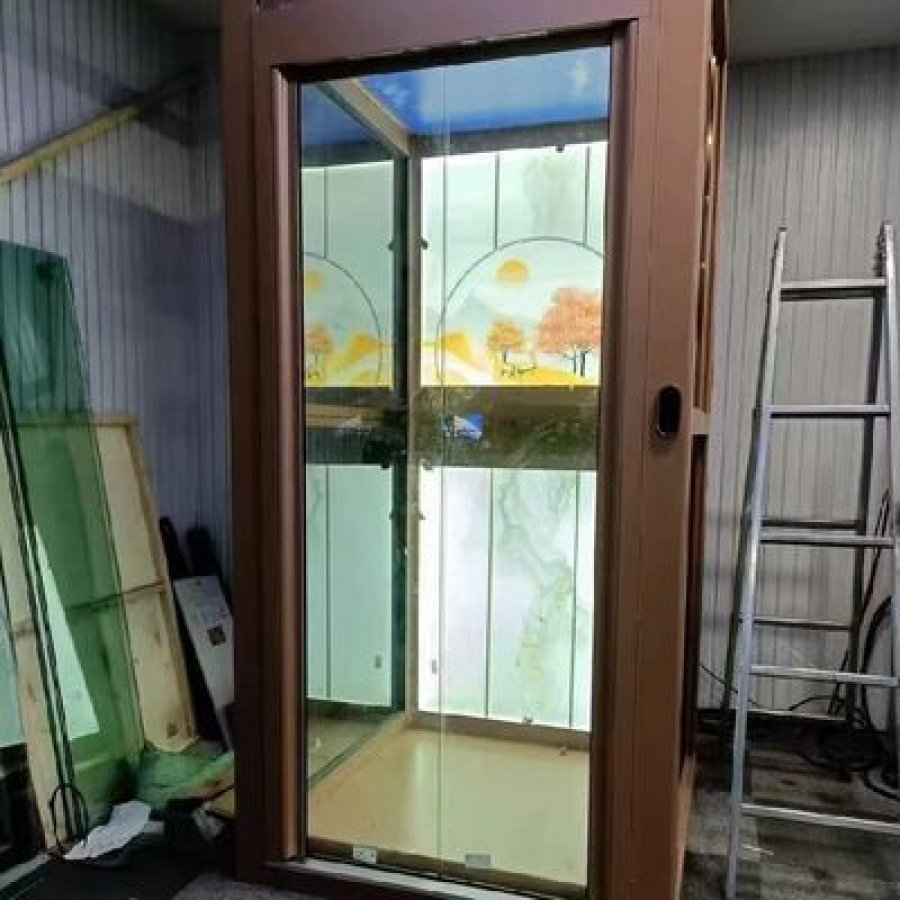
The photograph published with this model
One product photograph is published with this page, and it is the picture below. It shows the arrangement this article describes rather than a catalogue render, so it is worth opening at full size before you decide on a finish.
Doors at each landing
Automatic operation is only half of what a door has to do. The other half is the opening itself: how wide the clear opening is when the leaf is open, which way the leaf travels, and how the door sits relative to a corridor or a turn. This page publishes the door type and nothing further, so treat the opening arrangement as an item to confirm in writing before the order is placed.
Two questions are worth asking at that point. First, will the clear opening accept whatever has to pass through it - a wheelchair, a walking frame, a laundry basket or a suitcase? Second, will the open leaf block a corridor while the lift is in use? Both are layout decisions, and both are cheap on a drawing and awkward after installation.
If the finish is the deciding factor for your project, ask for the cabin drawings before you order. The published materials tell you what the car can be made of; the drawings tell you what it will look like in your stairwell.
7. Safety devices, the emergency stop and handover
Two safety features are published on this page: an emergency stop button and hydraulic safety. Those are the two the specification block names, and they are the two this article can describe. Anything beyond them is not published here, so nothing beyond them is claimed here.
The emergency stop is the part that passengers recognise. It is a control that cuts the movement of the lift when it is pressed, and it exists for the moment somebody needs the machine to stop immediately rather than at the end of its travel. Where it is mounted, and how it is reset, are not published on this page and belong in the handover documents for your machine.
What to check before you accept the machine
Handover is the point where a lift stops being a delivery and becomes part of the house. The list below is what to work through on the day, with the installer standing next to you. A checklist agreed in advance is more useful than a conversation afterwards.
0 / 10 ready
If the lift stops, work in this order
A lift that will not move is a household problem, and the first five minutes decide how long it lasts. The steps below are the general sequence for a microprocessor-controlled hydraulic machine. They are not a fault code list, because this page does not publish one, and they do not replace the technician.
| Symptom | What it usually means | Your next step |
|---|---|---|
| Nothing happens when a landing button is pressed | The controller is holding the lift - a door not fully closed, an isolation switch off, or a fault it has latched. | Check that the doors are closed, that the isolator has not been switched off, then read whatever the panel displays before calling. |
| The car stops between floors | The controller has stopped the drive rather than let the car continue. On a hydraulic machine the car does not fall when the drive stops. | Press the emergency stop if anyone is in the car and you are not sure what it is doing. Use the call system for your lift. Do not try to open a landing door. |
| The car runs but stops short of the floor | Levelling - the controller has not accepted the landing, or a sensor is not reading it. | Note the floor and how far short it stops. That one detail usually points the technician straight at the cause. |
| An indicator or display holds a number or a letter | A stored fault code. It describes one circuit or one condition rather than the whole machine. | Write the code down exactly, and note what you were doing when it appeared. Do not clear it before the technician has seen it. |
| The lift is louder or rougher than it was | A change in the drive, the oil or a guide rather than a failure. It is usually cheaper to catch early than late. | Record it and book the service. Describe when it happens - on the way up, on the way down, at one particular floor. |
Write down what you saw before you call anybody. The three details that shorten every service call are the floor where it stopped, the code on the panel, and what the lift was doing at the time.
8. What an installation looks like from the site
A pitless lift is delivered as parts rather than as a finished box, and the sequence below is the order they come together. It is described from the householder's point of view, so the trades, the dust and the noise arrive in the order you will meet them rather than in the order a schedule would list them.
From approved drawing to handover
-
Survey and approved drawing
The floor-to-floor heights, the top landing headroom and the machine position are measured and recorded. The drawing that follows is the one everything else is built against, so this is the stage where a change costs nothing.
-
Base and preparation
The floor at the lowest landing is checked and prepared, and the electrical route is run while the walls are still open. Nothing arrives from the factory until the base and the supply are settled.
-
Shaft or enclosure
The enclosure goes up and is checked for plumb and square over the whole travel. This is the stage where a mistake is still cheap to correct, so it is worth measuring before the car is unpacked.
-
Machine, cylinders and car
The 2.9 m cylinders and the 2.2 kW power unit are positioned at the lowest landing, and the car is assembled inside the enclosure. The parts come through the access route you identified at survey stage.
-
Electrical connection and commissioning
The machine is connected to its own circuit, the controller is set up against the travel, and the lift is run to every landing. The doors are adjusted at each stop.
-
Handover
You ride the lift, press the emergency stop, and work through the handover list in section 7. The manual, the drawing and the code list stay with the house.
Sequence only. The published delivery time on this page is 45 days from the approved drawing and the confirmed order, and the site work around the delivery takes as long as your building takes.
Two parts of this sequence are worth preparing before the machine ships, because both of them are easier while nothing is standing in the position yet. The electrical route is the first, and the access route for a single phase home elevator of this size is the second. Neither is difficult, and both of them cost more once the enclosure is in place.
9. Service, spares and the one-year warranty
This page publishes a one-year warranty and nothing about a service interval. That gap is worth taking seriously rather than filling with a guess. A hydraulics-based home lift is a machine with oil in it, seals in it and a controller watching it, and a machine like that is looked after rather than left alone.
What the published controller changes is how much of that work is discovered rather than diagnosed. A panel that holds fault codes turns a vague complaint into a specific one, so a service visit starts with information instead of with a hunt.
One-year warranty
Published on this page and repeated in the parameter table. Ask what the year covers, what it excludes, and what you have to do to keep it valid, because the answer belongs in writing with the machine.
Service interval
Not published here. Ask the supplier for the interval that applies to your machine and write the first date in the diary the week the lift is handed over.
Hydraulic home elevator maintenance
The parts that need attention over time are the oil, the seals and the level of the drive rather than the structure. A technician who knows what to look at will list them at handover.
Spares and the finish
The published cabin materials are 304 stainless steel and aluminium alloy, which are standard finishes rather than bespoke ones. A panel damaged in ten years can be remade.
The controller
A microprocessor panel is the part that most affects how quickly a fault is found. Keep the code list with the manual, in the house, where the next person can find it.
What to record
Start a small log on the day of handover. Date, what happened, any code on the panel, and when it cleared. Over a few years that log is the most useful document the lift has.
Two documents make the first service cheaper. One is the fault code list for your machine, and the other is the drawing that was actually built. Ask for both at handover rather than after the first problem.
10. Questions buyers ask before ordering
The questions below are the ones that come up most often on enquiries for this model. Where this page publishes a figure, the answer uses it. Where the page is silent, the answer says so rather than filling the gap with a guess.
Does this lift need a pit?
No. The published pit depth is 0 m, which is why this machine suits houses that are already built. The drive stands at the lowest landing, so the floor below the car stays as it is. In exchange, the floor at that landing has to carry the machine and the top landing has to give the published 3 m of clear headroom.
How many stops and how much travel does it cover?
The published figures are up to five stops over 14.5 m of travel. A house that needs a sixth stop or a longer run is a different model rather than a stretched version of this one. Total your floor-to-floor heights before you compare quotations, because that number decides the machine.
What does the microprocessor control actually do?
It reads the position of the car and the state of the drive, then manages the valve and the motor against what it reads. Three things follow: the car meets the floor instead of drifting past it, the ride gets a controlled start and stop, and a fault can be reported as a code. Section 2 sets all three out.
Is a 2.2 kW home elevator powerful enough?
The published motor power on this page is 2.2 kW, and that is the figure to quote. This page publishes no rated load, so no load figure can be read into the motor rating. Give your intended use at enquiry and the machine is specified against it, rather than being assumed from the kilowatts.
What power supply does it need?
The published supply is 220 V, 50 Hz, single phase. That is a domestic supply rather than an industrial one, so the lift is usually an extra circuit rather than a new service. If your site runs at 60 Hz, or at a different voltage, say so at enquiry so the machine matches the site.
Can it be installed in a house that is already finished?
That is what the 0 m pit is for. The two items that decide it are the clear headroom at the top landing and the route the parts take in. Both are answerable from a photograph and a tape measure, so a finished house is a practical project rather than a problem.
What materials is the cabin made from?
The published cabin materials are 304 stainless steel and aluminium alloy, and the doors are published as automatic. Cabin size, clear door opening and interior trim are not published on this page, so those come from the drawing for your own machine.
What safety devices are published?
Two are named: an emergency stop button and hydraulic safety. This page does not publish a full safety schedule, a fire rating or a seismic qualification, and nothing on this page claims them. If your project needs a specific safety document, raise it at enquiry and it is answered for your destination.
Is the machine certified?
The parameter table beside the product photograph names ISO 9001, which is a quality management certification. It describes how the product is made rather than how one machine performs on one site. This page publishes no product level certification, and none is claimed here.
What happens if the power fails?
This page publishes no power failure behaviour and no standby power arrangement for this model. Treat it as a question to be answered in writing rather than assumed in either direction. It is a fair question to put in the first enquiry, and it can be answered for your specification.
How long is delivery, and what is the warranty?
Both are published. Delivery is 45 days, counted from the approved drawing and the confirmed order rather than from the first enquiry, and the warranty is one year. Ask what the year covers before you order, so that the terms are settled with the machine.
What does the price include?
The published price band sits in the parameter table beside the product photograph on this page. A made-to-order lift is priced from the travel, the stop count, the finish and the destination, so ask for a firm figure against your own drawing rather than working from the band.
11. What to send for a quotation
A made-to-order lift is priced from the building rather than from a catalogue, so the enquiry that gets a firm answer is the one that arrives with the building attached. The list below is what we work through in order. Anything you cannot answer is still worth sending as a gap, because a missing dimension we can ask about is faster than a complete set of guesses.
0 / 12 ready
What happens after you send it
We check the travel against the published 14.5 m, the stop count against the published five, and the position against the base and the access route. You get back an arrangement drawing to approve, a question, or a plain statement that the building does not suit this model. Any of those three is a faster answer than a quotation nobody can build from.
Where to look next
Three pages go deeper on the choices this one raises. The hydraulic home elevator range collects the models that share this drive. The single-phase automatic hydraulic home elevator publishes the same supply on a different travel, and the pitless hydraulic home elevator with emergency stop page publishes the same arrangement with a different car. Reading those three alongside this page answers most of the comparison work.
Two of the eleven sections decide most projects. Section 1 tells you whether the house fits the published envelope, and section 3 lists every figure this page publishes together with its source. Everything between them follows from those two answers.
Planning a microprocessor-controlled home lift?
Send the floor-to-floor heights, the clear height at the top landing and a photograph of the machine position, and the answer comes back against your building.
Send your survey dataWant to Know more details about this product
Similar Products