English
 Español
Categories
Contacts
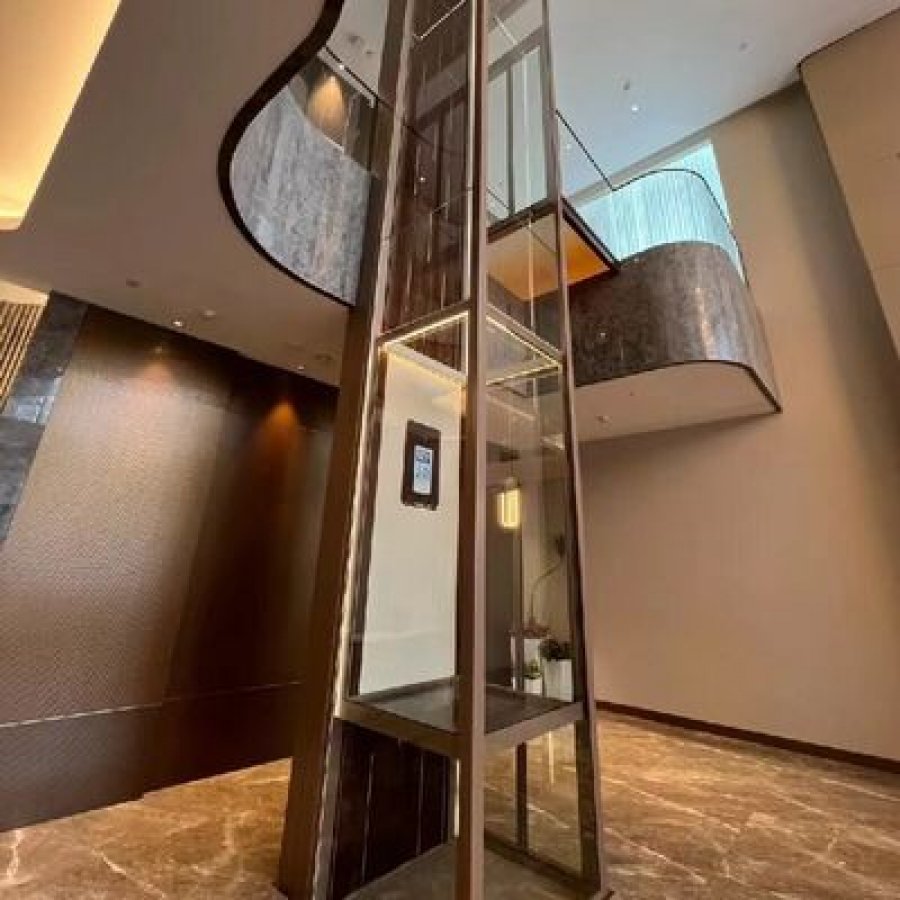
304 Stainless Steel Cabin Hydraulic Home Elevator | Pitless, 5 Stops
Product Details:
Brand Name
YIMEISITE
Place of Origin
China
Payment & Shipping Terms:
Minimum Order Quantity
1 Set
Price
USD 4,000-10,000 per set
Payment Terms
T/T,L/C
Supply Ability
10 Sets Per Month
Delivery Time
45 Working Days
Packaging Details
Export Non-Fumigation Wood Box
| Door Type: | Automatic | Max Height: | 14.5 M |
| Large Cylinders: | 2.9 Meter Length | Control System: | Microprocessor |
| Motor: | 4.7 Kw | Cabin: | 304# Stainless Steel/aluminium Alloy |
| Pit Depth: | 0 M | Warranty: | 1 Year |
| Highlight: | home hydraulic elevator microprocessor,304 ss cabin elevator,304 home hydraulic elevator | ||
Product Description
A 304 stainless steel cabin home elevator is bought for one reason: the cabin has to survive a wet or salty house without turning into a maintenance item
Most cabins on the market are stainless steel on paper. The grade is where they differ. This page carries a hydraulic home elevator whose cabin is specified as 304# stainless steel or aluminium alloy, with a 0 m pit, up to 14.5 m of travel and 5 stops. It is the same sheet a buyer reads when the house sits near the sea, above a garage that floods, or in a region where the air is damp for eight months of the year.
A stainless steel cabin home elevator is not automatically a 304 lift. Plenty of suppliers write “stainless steel” and fit a 201 cabin that looks identical on the day it is unpacked and behaves quite differently three winters later. The difference is not cosmetic, and it is not visible in a photograph: it is in the alloy, and it shows up as brown freckling on the panel you walk past every day.
The short version
- What it is: a pitless hydraulic home elevator with a 304# stainless steel or aluminium alloy cabin, automatic doors, microprocessor control and a 4.7 kW motor, running on 2.9 m large cylinders to a maximum height of 14.5 m over 5 stops.
- What 304 changes: it is the austenitic grade with roughly 18% chromium and 8% nickel, so it keeps its passive film in chloride air where a 201 cabin (chromium plus manganese, little or no nickel) starts to pit. That matters in coastal and humid houses; it matters much less in a dry inland core.
- Why hydraulic on a retrofit: 0 m pit and about 3 m of overhead clearance mean the lift can go into a finished house without an excavation or a machine room above the shaft.
- Fixed on this sheet: 304# or aluminium cabin, automatic doors, microprocessor control, 4.7 kW motor, 2.9 m cylinders, 0 m pit, 5 stops and 14.5 m maximum height. Commercial lines: 1 year warranty, brand YIMEISITE, USD 4,000–10,000 per set, MOQ 1 set, T/T or L/C, 45 working days, export non-fumigation wood box.
- Still open, and worth settling before you compare prices: rated load, travel and stop count for your own house, and the car and shaft dimensions. Also open: running speed, panel finish, the supply at the meter, and any certification your building authority asks for. Contact our engineers. None of those appears on the sheet, and this page will not invent them.
1. Does this lift need a 304 stainless steel cabin?
A stainless steel cabin home elevator is a residential lift whose car walls are built from stainless sheet rather than painted steel, laminate or glass. The sheet is the part of the lift a household actually touches, and the grade of that sheet decides how it looks after a few years of humid air, cleaning chemicals and fingerprints. When a supplier advertises a 304 stainless steel elevator, the cabin grade is the claim being made, and it is worth getting in writing.
Two questions separate the projects where 304 earns its premium from the projects where it is money spent on a property nobody will ever look at closely. The first is the environment at the door of the lift. The second is how visible the car is once it is running. Work through the three cards below before you ask for a price; they are the same three questions a supplier should be asking you.
304 earns its keep
- The house is within a few kilometres of the sea, or on a coast where salt mist reaches the windows.
- A lift door that opens into a bathroom-adjacent corridor, an indoor pool hall, a laundry or a spa room — somewhere the air is warm and permanently damp.
- The building sits in a tropical or monsoon climate where relative humidity stays high for most of the year.
- A cabin on show, opening into a living room or a stairwell, where every mark on the panel sits in the main daily sightline.
- You clean with anything that comes to hand, including chlorinated or acidic bathroom products.
- The building is expected to stand for decades and the cabin is not going to be replaced during that time.
Decide on finish, not grade
- Dry inland houses with a climate-controlled core: 304 and 201 behave almost the same, and the visible difference is the finish, not the alloy.
- Service lifts in plant rooms or back-of-house shafts, seen twice a week rather than lived with.
- Short-life installations, temporary buildings, or projects where the lift is replaced before the cabin is.
- Houses where the aluminium alloy cabin listed on this same sheet already fits the design language and the budget.
Handle with care
- Nobody will clean it. Fingerprints and salt film left on any stainless grade for years will eventually leave a mark, 304 included.
- You plan to scrub it with steel wool, wire brushes or abrasive cream — that destroys the passive film regardless of grade, and 304 is no protection against a scratch pad.
- The cabin will sit in contact with a dissimilar metal, wet carbon steel or a chloride-rich adhesive.
- You are buying on price alone and will not compare grades side by side. Ask what grade is quoted; a “stainless steel cabin” line item with no number on it is the single most common gap in this category.
One honest limit up front. This sheet does not state a rated load, a running speed, a car size or a shaft size, and the parameter table carries no certification row at all. Those are not oversights in this page: they are simply not on the source data, and this page will not invent them. If you need a specification to submit for approval, send the requirement and it comes back against the real figure rather than a rounded one. Contact our engineers.
What the sheet does fix is the geometry that usually decides whether a domestic lift can be installed at all. A pit depth of 0 m removes the excavation, and roughly 3 m of overhead clearance removes the rooftop machine room. Together with 5 stops and a maximum height of 14.5 m, that is enough to plan a four- or five-level house — and enough to say a clear no to a project that needs 6 stops or 16 m. Contact our engineers.
Reading this page in a hurry? The three cards above are the decision. Everything after them is the detail behind it: which metal to pick, what the sheet says, how a coastal house changes the installation, how to clean the cabin, and what to send for a quotation.
2. 304 vs 201 vs aluminium: choosing the cabin metal
Buyers ask for a stainless steel cabin home elevator in three different situations, and only one of them needs 304. Understanding what the three options are made of removes most of the guesswork.
What each of the three materials is
304 is an austenitic stainless steel with roughly 18% chromium and 8% nickel. The nickel is what keeps the crystal structure austenitic and lets the surface form a stable, self-repairing oxide film. That film is the whole point: it re-forms in air after a scratch, and it is what stops the panel from rusting when chloride ions land on it.
201 replaces most of the nickel with manganese. It is cheaper, it machines and polishes well, and on a dry showroom panel it is indistinguishable from 304. In chloride-rich or continuously damp air the film is less stable and the usual result is pitting: small brown freckles that grow into rough patches.
Aluminium alloy is the third line on this page's cabin row, and it is a genuinely different proposition rather than a cheaper stainless. It is lighter, so the moving mass of the car drops; it does not pit the way a low-nickel stainless does; and it can be anodised or powder coated into colours stainless cannot reach. What it does not have is the hard, cold, brushed-metal look that a client is usually asking for when they say “stainless”.
| Question | 304 stainless steel | 201 stainless steel | Aluminium alloy |
|---|---|---|---|
| Typical composition | About 18% Cr, 8% Ni | Cr with manganese replacing most nickel | Aluminium with magnesium or silicon alloying |
| Behaviour in salt air | Passive film stays stable at normal coastal exposure | Film breaks down; freckling and pitting are the usual outcome | No pitting mechanism, but a bare surface oxidises and needs a coating |
| Humid indoor air | Unaffected at ordinary humidity | Usually fine, until the room is permanently damp | Fine; anodised surfaces handle humidity well |
| Appearance | Brushed or mirror metal, cool grey, hard to fake | Looks the same when new | Matte, coloured or wood-effect after coating |
| Weight of the car | Heaviest of the three | Slightly lighter than 304 | Lightest; the easiest on a retrofit frame |
| Scratch repair | Brush marks blend; deep scratches stay | Same, but corrosion may follow the scratch | Coating damage is visible and needs a touch-up coat |
| Cleaning tolerance | Dilute household cleaners only; no chloride bleach left to dry | Less tolerant, same cleaning rules apply | Check the coating; solvent cleaners can dull it |
| Where it belongs | Coastal houses, pool and spa areas, humid climates, visible cabins | Dry inland interiors on a tight budget | Design-led interiors, low-mass retrofits, colour-matched fit-outs |
How to tell which grade you were quoted
Ask for the grade in writing, not the words “stainless steel”. A quotation that reads cabin: 304# stainless steel is checkable; one that reads cabin: stainless steel is not. If the answer comes back as 201 or as “we use whatever is available”, treat the coastal case as unproven and price the aluminium option instead.
On this page's sheet the cabin line reads 304# stainless steel or aluminium alloy. That is a material claim about the build, not a certificate: the sheet carries no certification row, so this page does not claim CE, ISO or any other approval for it. If your authority requires one, request it separately and it is issued as a document rather than as a line on a product page. Contact our engineers.
3. The specification sheet, item by item
Everything this page publishes about the lift is in the table below. Read it before the price, because three of the nine lines decide whether the installation is possible in your building at all: the 0 m pit, the 2.9 m cylinders and the automatic door.
Switch the units if you work in feet and horsepower. The metric figures are the ones printed on this page's sheet; the imperial column is a rounded conversion for planning, not a second specification.
Units
Conversions are rounded to the nearest inch or tenth, for planning and site discussion only.
| Item | On this sheet | What it decides |
|---|---|---|
| Door type | Automatic | Powered car and landing doors rather than a manual gate. It sets the landing clear opening, adds a door operator to the top of the car and needs a power feed at each landing. |
| Maximum height | 14.5 m47 ft 7 in | The highest travel this model is built for. It caps the house at five levels of roughly 2.9 m floor-to-floor; a taller house needs another model. Contact our engineers. |
| Stops | 5 | Five landings, so four levels of travel above the lowest. A basement plus three upper floors is the normal fit. |
| Pit depth | 0 m0 ft | No excavation. The car floor and the finished floor are at the same level, and the hydraulic cylinder sits in the ground beside the car instead of under it. This is the line that lets the lift go into a finished house. |
| Overhead clearance | about 3 mabout 9 ft 10 in | The clear height needed above the top landing. It replaces the rooftop machine room a traction lift would need, which is what keeps a glazed or open stairwell usable. |
| Large cylinders | 2.9 m length9 ft 6 in length | The hydraulic ram length for this travel. Cylinder length and travel are fixed together, so a longer shaft means a longer cylinder, not the same one stretched. |
| Motor | 4.7 kWapproximately 6.3 hp | The pump motor driving the cylinder. It sets the electrical load and the size of the supply circuit the electrician has to allow for. |
| Control system | Microprocessor | Electronic levelling and call handling in place of relay logic. It is what makes a hydraulic lift stop level at each floor instead of drifting to a stop. |
| Cabin | 304# stainless steel or aluminium alloy | The car walls. This is the line the whole page is about: the grade is named, and the aluminium alternative is named beside it. |
| Warranty | 1 year | One year from the sheet. What that covers, and whether the cylinder and the controller are inside or outside it, is not stated here. Contact our engineers. |
| Power supply | Single-phase 220 V, 50 Hz. Contact our engineers. | Stated in this product's own description rather than in the parameter table. Confirm the voltage and frequency at the meter before ordering; a 60 Hz market must be checked separately. |
What this sheet does not state
Four of the numbers a structural engineer or a building authority will ask for are missing from the source data. They are listed here so nobody plans around an assumption:
- Rated load. No kg or person figure appears on this sheet. Do not size the lift from the 4.7 kW motor; the two are not related. Contact our engineers.
- Running speed. No m/s figure. A hydraulic domestic lift normally runs between 0.15 and 0.4 m/s, but this page will not put a number on a sheet that has none. Contact our engineers.
- Car and shaft dimensions. No cabin footprint and no shaft opening size. Both are set by the layout, so this is the first drawing to ask for. Contact our engineers.
- Certification. The parameter table carries no certification line, and a full-page search returns no standard or approval statement. This page therefore claims none. If your authority needs one, ask before ordering. Contact our engineers.
4. Coastal and humid houses: what 304 actually buys
Salt is the reason this page exists. A coastal home elevator lives or dies on the passive film of its cabin panels: sea air carries chloride ions, chloride attacks that film, and the grade with more nickel resists the attack for far longer. The mechanism is well understood, and it is worth three minutes because it decides how a supplier should build the cabin, the frame and the fixings for your site.
There are three exposure conditions a residential lift can be specified for. They are not a ranking of quality; they are three different sets of instructions for the same lift.
Coastal · salt in the air
Windows facing open water, prevailing onshore wind, salt mist reaching the building envelope. This is the case 304 was chosen for.
- Cabin: specify 304# and keep it. Do not accept a substitution to 201 at the last minute; the two are indistinguishable in a sample book.
- Routine: wipe the cabin with fresh water and a soft cloth at least twice a year, more often if the windows are open. Salt film that is never washed off does eventually mark even 304.
- Landings: keep the door track and sill clear. Salt-laden grit collects there and grinds.
- Chemicals: never leave swimming-pool sanitiser, tile cleaner or acid descaler on the metal. Rinse after use.
- Fasteners: ask for stainless fixings in the car and frame. A 304 panel bolted with plain carbon steel screws will corrode at the screw, not at the panel.
Humid · damp air, no salt
Tropical and monsoon climates, spring rooms, pool halls, laundry and bathroom corridors. Warm damp air rather than chloride.
- Cabin: 304 is comfortable here and removes the corrosion question entirely.
- Shaft: the important part is ventilation, not grade. A trapped, permanently damp shaft will corrode hinges, locks and fixings whatever the cabin is made of.
- Condensation: if the shaft sits against an exterior wall, expect seasonal condensation on cold metal. A wipe-down schedule is cheaper than a repair.
- Pool rooms: keep chlorinated water off the car. If the lift opens directly into a pool hall, treat the installation as coastal.
Dry inland · ordinary house air
Heated or air-conditioned inland interiors. No salt, no standing damp. The majority of residential installs.
- Cabin: the aluminium alloy option on this same sheet is usually the sensible choice, or a 201 cabin if the budget is tight.
- 304 still makes sense here if the cabin is a focal point and the client wants the metal look, or if the house is expected to change hands in a coastal market.
- Cleaning: twice a year with a damp cloth is enough. Do not polish it into a mirror finish by hand; you will not match the original brush direction.
The grade of the cabin gets the attention. Three other decisions cause most of the corrosion complaints on residential lifts in wet and salty buildings.
Three details that matter more than the grade
Dissimilar metals. Stainless in contact with plain carbon steel, with galvanised brackets, or with a zinc-rich fixing, creates a small galvanic cell wherever moisture bridges the two. In coastal air it is usually the cheaper metal that disappears and the stainless that gets stained. Ask for the fixing schedule rather than assuming everything is stainless.
Trapped moisture in the shaft. A shaft with no air movement keeps condensation on its lower walls for months. The lift is a machine in a damp cupboard. Louvred doors, a vent at the top of the enclosure or an extract path costs very little at build stage and cannot be added cheaply later.
Cleaning products. The most common cause of stainless pitting in domestic buildings is not the sea. It is a chloride-containing bathroom or pool cleaner left to dry on the panel, or an abrasive pad used to remove a scuff. 304 resists chloride ions far better than 201, but no stainless grade is immune to a bleach solution left standing in a warm room.
5. Cleaning brushed and mirror stainless steel
A stainless steel cabin fails in two ways, and only one of them is corrosion. It can pit, which is a chemistry problem, or it can dull, which is a cleaning problem. Both are controllable, and neither requires a specialist contractor if the household is given a short, correct routine at handover.
The routine depends on the finish. A brushed finish has a visible grain direction; a mirror finish reflects cleanly and shows everything. The two need different handling, so check which one your cabin uses before the first clean.
The routine, in order
- Dust first, dry. Use a microfibre cloth with no product on it. Wiping a dry panel removes most of the day-to-day film and avoids dragging grit across the surface.
- Wipe along the grain. On a brushed panel, follow the direction of the existing lines only. Working across the grain leaves a permanent cross-hatch that shows under raking light.
- Use fresh water and a mild neutral soap. A few drops of washing-up liquid in warm water is enough. The job is to lift salt, dust and grease — not to sterilise the metal.
- Rinse with clean water. This is the step households skip. Residue from soap or from a chlorinated cleaner left to dry is what causes most domestic pitting.
- Dry with a separate cloth. Air-drying in a humid room leaves water spots on mirror panels and a faint haze on brushed ones.
- Leave it alone. Do not oil, wax or polish stainless regularly. Most “stainless polish” products build a film that traps dirt and ends up looking worse than the bare panel.
What not to use, and why
Four things damage stainless cabins in houses often enough to be worth naming. Abrasive creams and scouring powders scratch the surface and break the passive film where they scratch. Steel wool and wire brushes deposit free iron into the panel, which then rusts and looks like the stainless itself is failing. Chloride bleach left to dry is a direct cause of pitting, on 201 quickly and on 304 more slowly. And strong acid descalers, the sort sold for bathroom limescale, will etch a mirror panel within minutes.
If a cleaner has to be used on the landing floor beside the lift, apply it to the floor, keep it off the door track, and rinse the sill afterwards. Cleaning a bathroom floor with a chlorine product and walking into the lift with wet shoes is a more common route to cabin staining than weather.
Removing fingerprints from the door and car panel
Fingerprints are body oil and are removed by the same soap-and-rinse routine. On a mirror finish they will come back within a day, which is a property of the finish rather than a fault in the material; households that use the lift constantly usually prefer brushed for exactly this reason. If the cabin has a coated or anti-fingerprint finish, clean it with water only and check with the supplier before using any product on it.
Handover cleaning kit — tick what your household actually has0 of 6
6. Cabin, doors and finish options
Four decisions sit inside this section, and the cabin metal from section 2 is only the first of them. The others are the door, what the household sees through, and how the car reads against the interior it opens into.
Automatic doors
The sheet specifies automatic doors, so the car and landing doors are powered rather than a manual gate. That is the configuration that makes a domestic lift usable by children and older residents, and it is also the one that needs a supply at every landing and a clear opening sized before the builder frames the shaft.
304 stainless car
The default finish on this sheet: panels, ceiling and car door in 304# stainless steel. Brushed reads as brushed metal and hides everyday marks; mirror is the showroom look and reflects the landing back at itself. Both are the same alloy; only the surface treatment differs.
Aluminium alloy car
The alternative named on the same cabin line. Lighter, coatable into colour, and a sensible pick for a dry interior where the stainless look is not the brief. Ask for a coated sample to see the actual shade; colour photographs of aluminium are unreliable across screens.
Shaft sides
How much of the shaft is closed is a design decision with a maintenance consequence: an open or glazed shaft shows the cylinder and the running gear, and every part of it has to be kept clean. A closed shaft hides the machinery but gives up daylight. Neither is wrong; they cost different amounts of attention.
Landing sills and tracks
The sill is where grit and water collect, and it is the first thing to look tired on any lift. Specify a sill that can be lifted out or cleaned in place, and keep the track clear of building sand during the fit-out rather than after it.
Interior fittings
Handrail, ceiling light, mirror and flooring are where a standard car becomes a fitted one. Handle, glass, mirror and flooring are not specified on this sheet, so they are quoted per project. Contact our engineers.
Looking at the actual lift
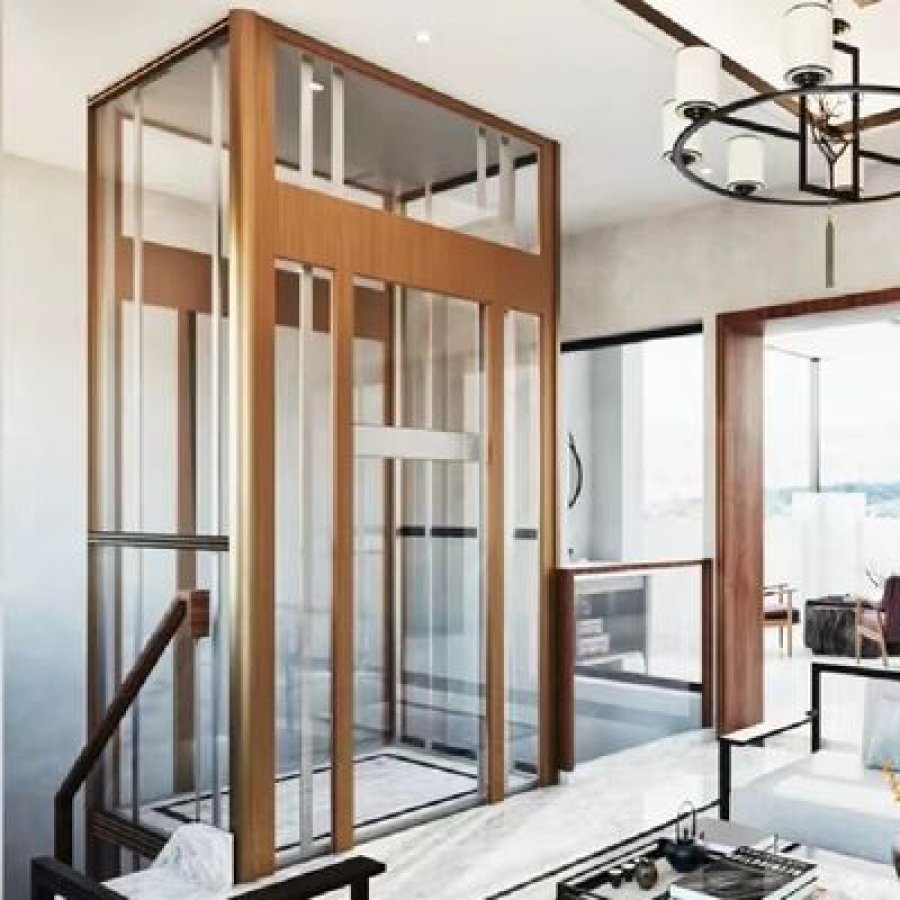
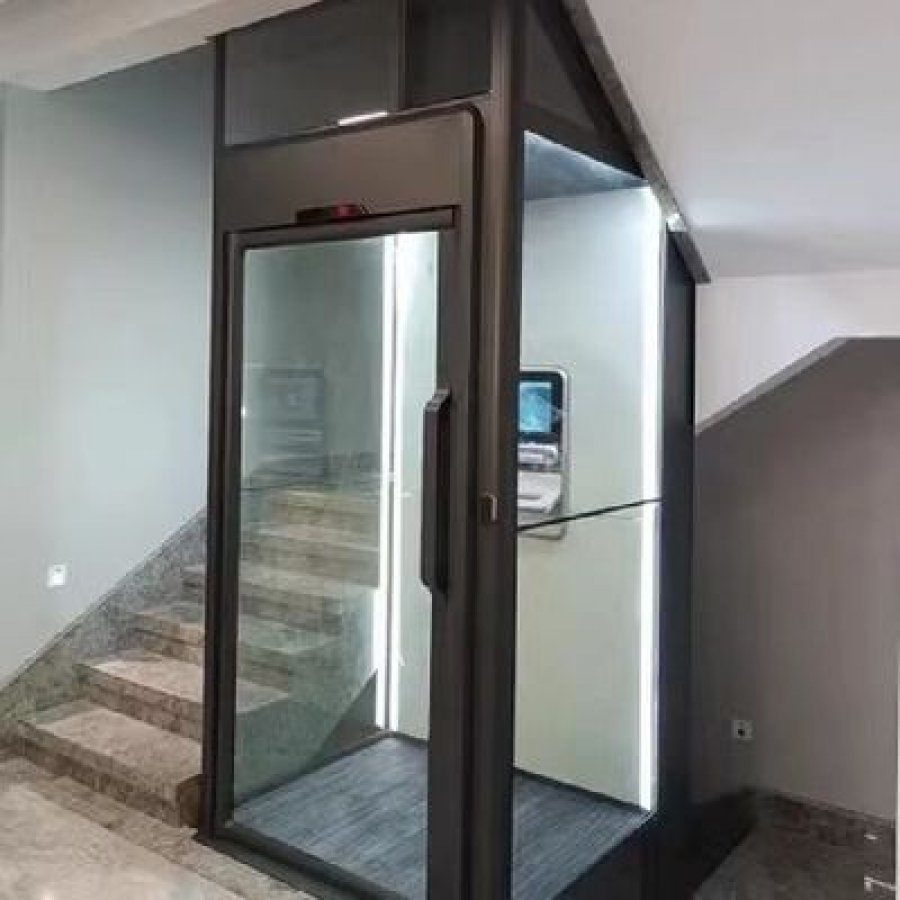
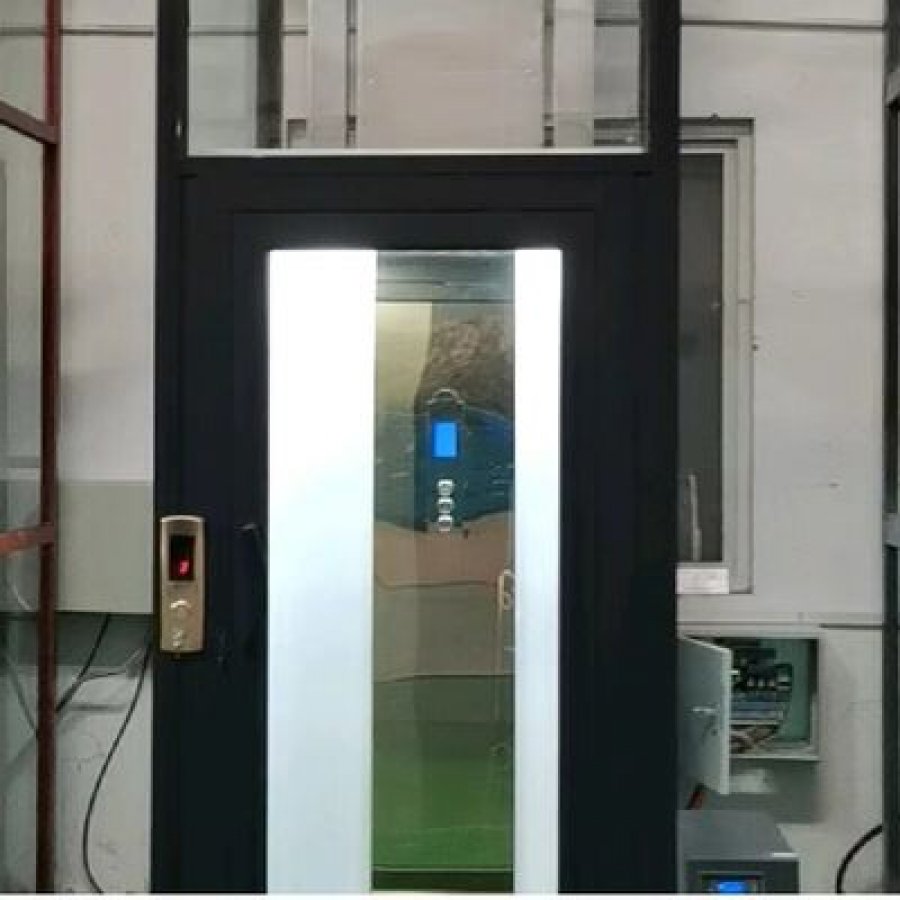
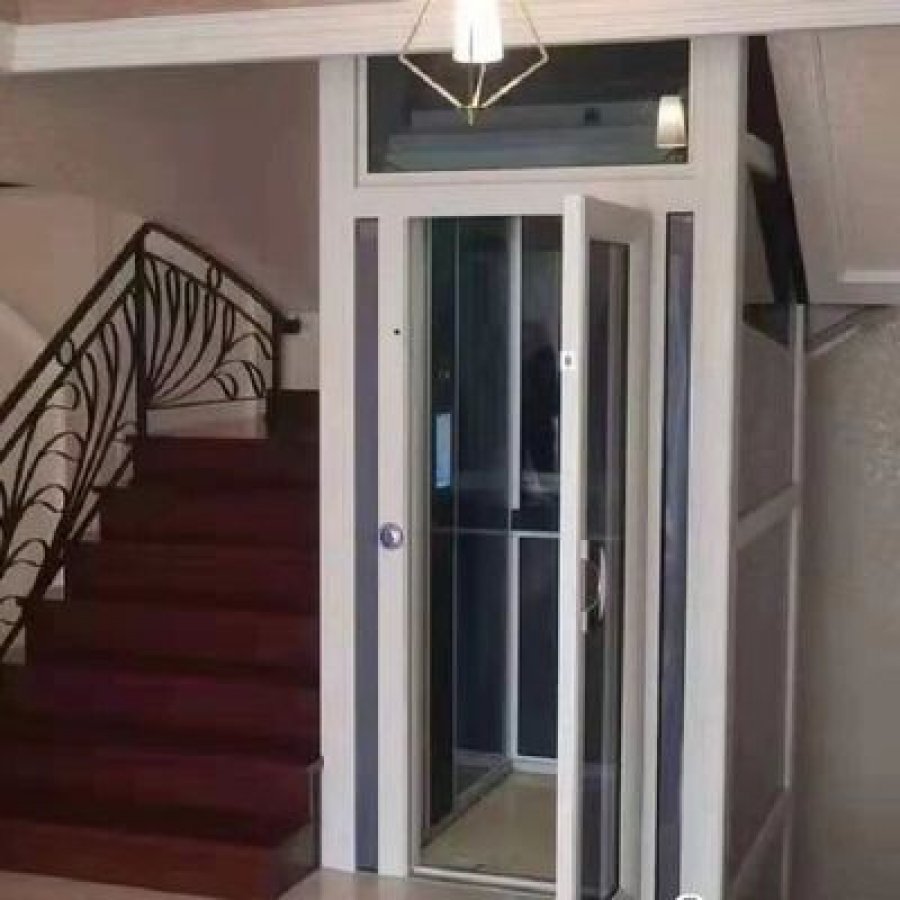
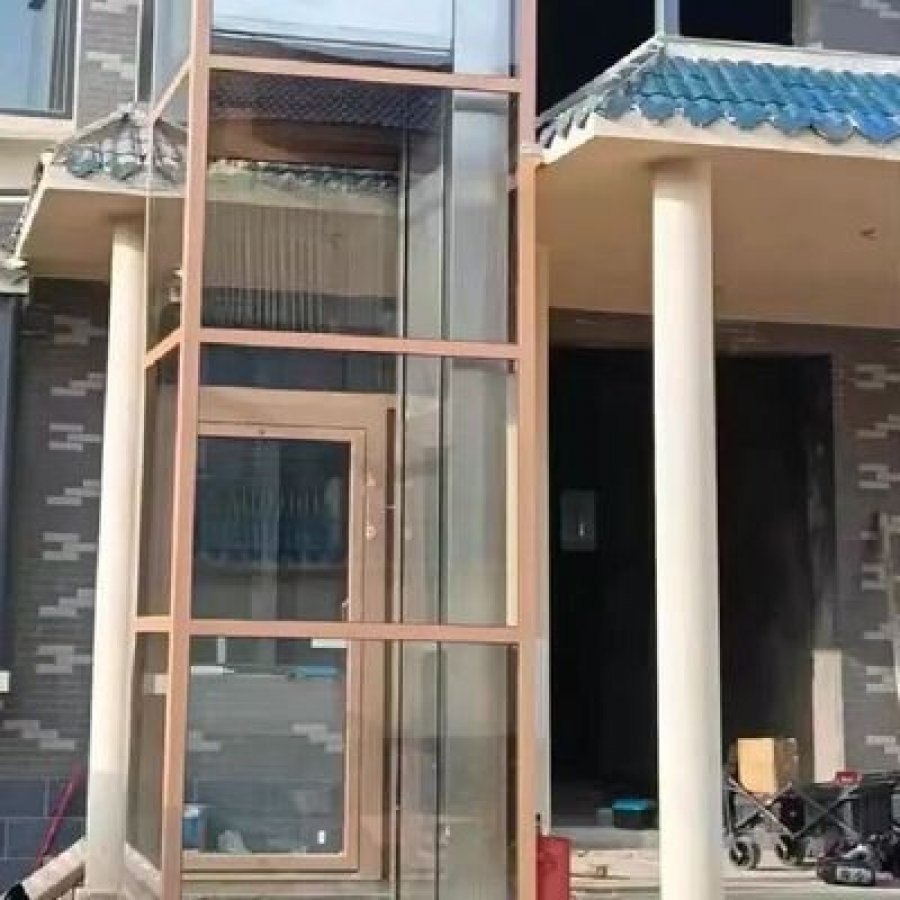
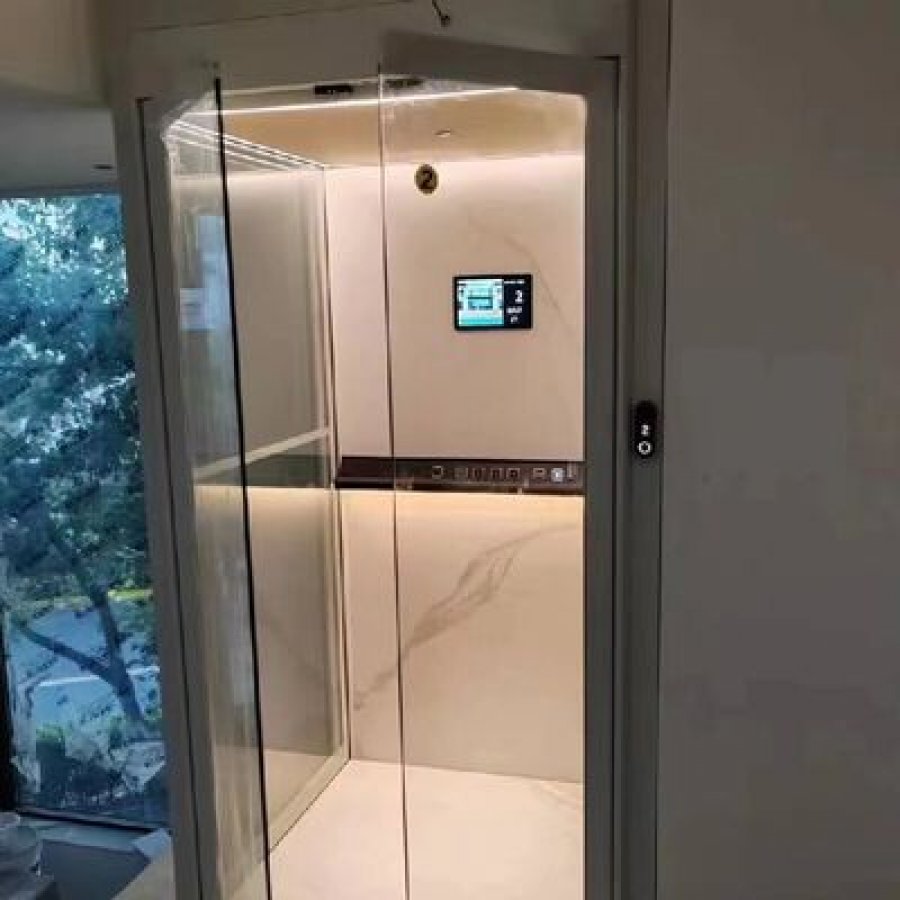
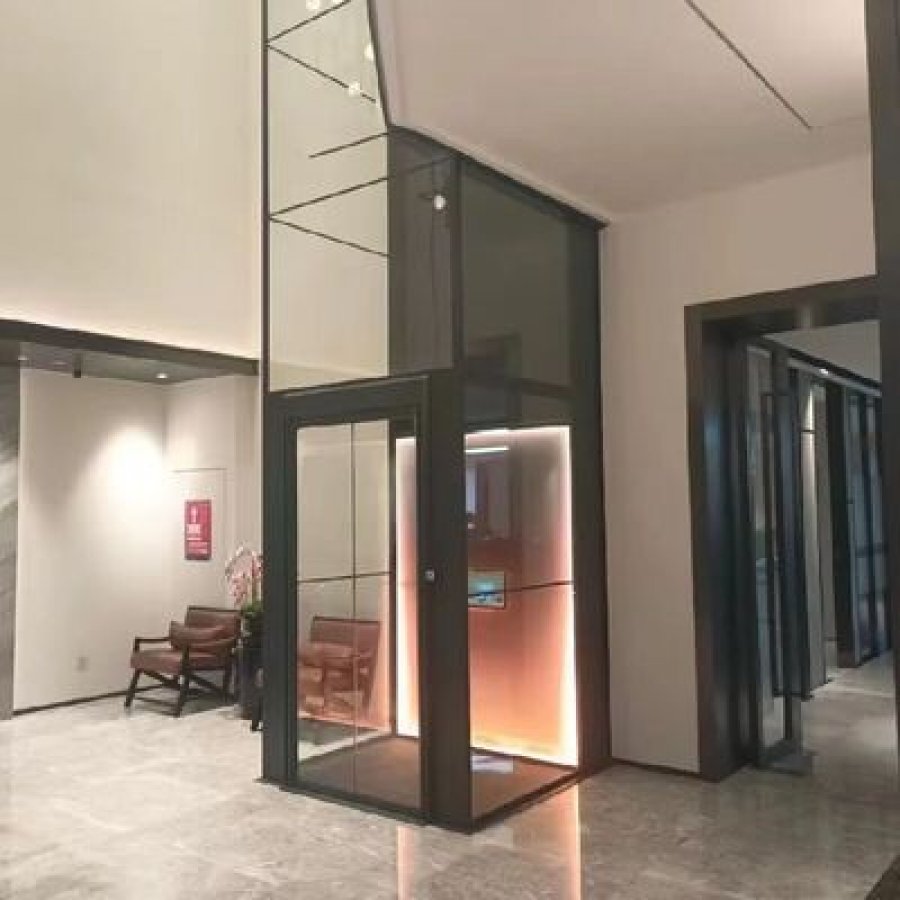
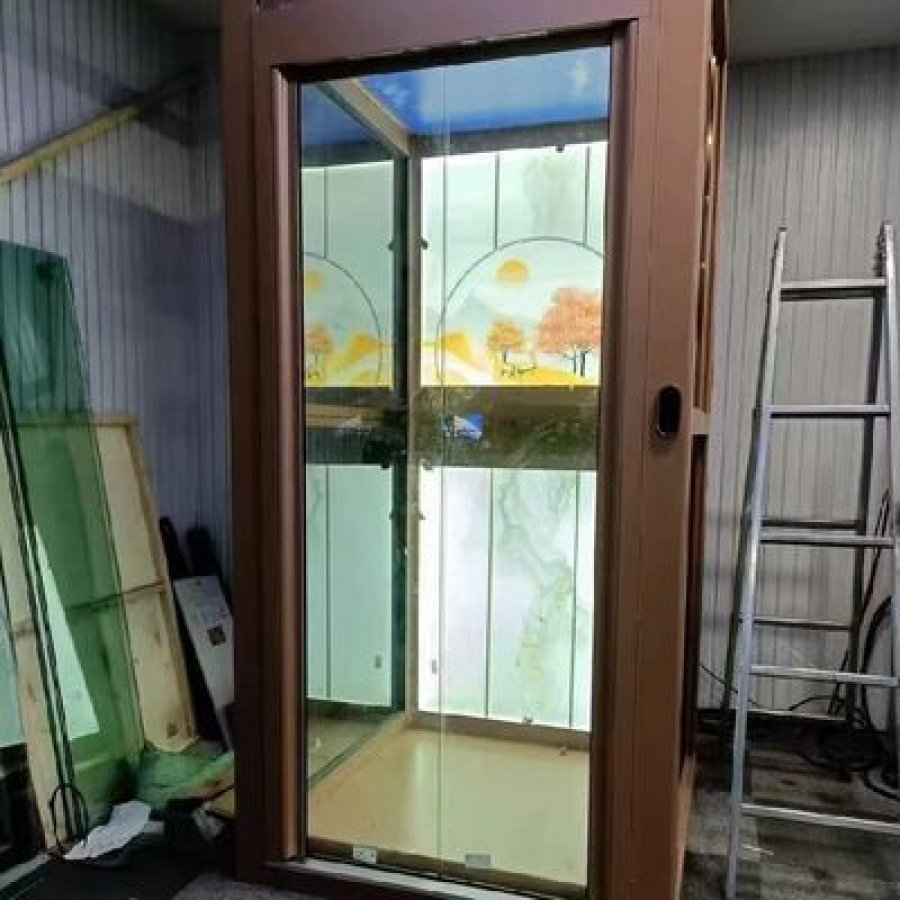
Photographs decide most finish arguments faster than a specification does. This page carries one product photograph of the cabin; click it to open it at full size. Anything a single image cannot settle — the panel joints close up, the door reveal, brushed against mirror under your own lighting — is worth asking for before the order rather than after it. Contact our engineers.
Two things to look for in the images. First, the door line: where the car door meets the landing door, and whether the frame around it is a visible profile or a flush reveal. Second, the panel joints on the side walls: a cabin built from wide panels has fewer vertical lines and reads more like a solid box, while a narrow-panel cabin reads as engineered metal. Both are legitimate; only one will match the interior you are building.
If the cabin you are shown differs from the cabin you receive, that is a grade or finish substitution, not a shipping error. Record the grade, the finish direction and the panel thickness on the purchase order. Three lines on a document are cheaper to negotiate than a replacement car.
7. Power, control and the electrical check
A hydraulic lift is mechanically simple and electrically unforgiving: it draws a large current for a short time on every trip, and it does so from a motor that has to start under load. Getting the supply right at design stage costs almost nothing. Correcting it after the shaft is built and tiled can mean a new cable run through a finished house.
Two figures are published on this sheet and both matter here. The motor is 4.7 kW, and the controller is a microprocessor system rather than relay logic. The supply is given as single-phase 220 V, 50 Hz in this product's own description — not in the parameter table, which is why it is flagged. Confirm it against the meter before ordering. Contact our engineers.
Supply is workable
- A dedicated circuit is available or can be pulled from the distribution board to the machine position, with a local isolator next to the power unit.
- The supply is 220–240 V at 50 Hz, matching the sheet. Frequency matters as much as voltage: a 4.7 kW 50 Hz motor run on 60 Hz turns faster and needs the pump and relief settings checked before it is put into service.
- Earthing and a residual-current device are in place on the circuit.
- The cable run from the board to the power unit is short, or sized for the volt drop at starting current.
- The power unit position is dry, ventilated and accessible for oil checks and manual lowering.
Needs an electrician first
- The lift is planned on an existing lighting or socket circuit.
- The property is on 60 Hz and the supply has not been compared with the sheet.
- A power unit reachable only through a bathroom, a cupboard under a staircase, or a space that floods.
- The house runs on a generator or an inverter without a start-up test. A 4.7 kW motor starting under load is a much harder load on an inverter than its continuous rating suggests.
- Nobody has checked the voltage drop on a long run to an outbuilding or a detached annexe.
What the controller does, and what it does not
Microprocessor control is the reason a hydraulic lift can be expected to stop level at each floor. The controller reads the floor positions, manages the call logic and holds the car at the landing; without it, a hydraulic car can settle slightly below the sill after a few minutes as the oil cools.
Checks to give the electrician before the shaft is finished
- Circuit rating and cable size for a 4.7 kW single-phase motor on the sheet's stated supply. Contact our engineers.
- Isolator position at the power unit, reachable without entering the car or climbing into the shaft.
- Protection type: the board or the installer can confirm whether the lift needs a dedicated RCD and whether starting current will hold it in. Contact our engineers.
- Bonding of the car and shaft metalwork to the protective earth, which is a separate requirement from the supply cable itself.
- Manual lowering point and its power supply; typically the pump has a hand valve, and the household must know where it is.
8. Installation sequence and handover checks
A pitless hydraulic lift is one of the few domestic lift types that can go into a house that is already lived in, because the work is mostly above the floor rather than below it. The sequence below is the order that keeps the household least disrupted and the survey most useful; the durations are typical for this type of installation and are given to plan around, not as a commitment. Contact our engineers.
Step 1 · before ordering
Site survey and shaft check
Measure the finished floor to finished floor heights, the available footprint at each landing, and the clear height above the top landing. This is where the 14.5 m maximum and the 5 stop limit of the sheet are either confirmed or exceeded. Take photographs with a tape in frame; they settle most later disagreements about access.
Step 2 · before ordering
Confirm the load and the supply
The two open items on this sheet. The load rating is not published, so state the number of people and the internal load the lift has to carry and have it confirmed in writing; the supply has to be checked at the meter. Both are pre-order questions, not installation questions. Contact our engineers.
Step 3 · on site, typically 2–5 days
Shaft construction or preparation
Build the enclosure to the confirmed drawing, or prepare the existing opening. With a 0 m pit there is no excavation, but the floor at the lowest landing still has to be level and structurally able to take the cylinder base and the car load. Leaving access panels for the machine and the cylinder base costs nothing now and saves cutting a finished wall later.
Step 4 · typically 2–4 days
Guide rails and cylinder installation
Fix the guide rails, then set the 2.9 m cylinder for this travel. On a pitless domestic lift the cylinder sits beside the car, and its base has to be plumb to a tight tolerance. A base that is out by a few millimetres shows up later as a car that drifts off the door line at the top landing.
Step 5 · typically 2–4 days
Power unit, piping and car assembly
Position the power unit where it can be serviced, run the hydraulic line, then build the car on the guide rails. This is the point at which a panel substitution would become visible, so the cabin panels should be checked against the purchase order before they are hung rather than after the car is complete.
Step 6 · typically 1–2 days
Doors, sills and landing finish
Install the automatic car and landing doors, then set the sills. Door alignment is measured against the finished floor, so the floor finish has to be decided before this step; a 10 mm change in finished floor level after the doors are hung means re-setting them.
Step 7 · typically 1–2 days
Commissioning and levelling
Fill and bleed the hydraulic circuit, set the levelling through the microprocessor controller, and run the car through every landing. Levelling is the test that matters for a hydraulic lift: the car has to arrive at the sill line and stay there while loaded.
Step 8 · handover
Handover and documentation
Instructions for use, the manual lowering point, the emergency stop, the oil check interval and the cleaning note from section 5. Ask for the commissioning sheet and any test record at this point; after the installer leaves, it is much harder to obtain.
What to check before you sign it off
- Level at every landing, loaded and unloaded, with the car stopped at each stop and left for several minutes.
- Door operation at every landing, including the light beam or safety edge if fitted, and that the car will not move with a door open.
- Emergency stop and the behaviour of the car after it is used.
- Manual lowering demonstrated once by the installer and once by you, with the household watching.
- Oil level and any leaks under the power unit and along the hydraulic line.
- Cabin condition: every panel free of transit scratches, protective film removed, grain direction consistent from panel to panel.
- Gaps and fixings: no visible packing shims, no exposed fixings that are not stainless in a wet building.
9. Service, spares and the warranty
A hydraulic lift is serviced less often than a traction lift and in a smaller number of places. The trade-off is that the places it does need attention are fluids and seals, and those fail slowly rather than suddenly. A short annual visit is usually the difference between a lift that runs for two decades and one that starts marking its floor with oil.
What this sheet states about support is one line: a 1 year warranty. It does not say whether the cylinder, the pump unit and the controller are inside that year or outside it, and it does not state a service interval. Both should be settled in the order. Contact our engineers.
What is on this sheet
1 year warranty. Brand YIMEISITE, origin China, 45 working days delivery, export non-fumigation wood box, supply ability 10 sets per month. Spare parts availability, warranty exclusions and the response route for a fault are not stated and have to be requested.
Hydraulic side
Oil level and oil condition, the pump and its filter, the relief and lowering valves, and the cylinder seals. The oil and the seals are the parts that age; the pump is the part that fails if the oil is never checked. Ask for the specified oil grade and the check interval in writing.
Mechanical side
Guide rail fixings, car and door rollers, door tracks and sills, and the landing door locks. Most domestic lift call-outs are door faults, and most door faults are a track full of building grit or a roller that has not been lubricated since installation.
Electrical side
The microprocessor controller, the landing wiring and the earth bonding. Controllers usually fail from water, damp or a sagging supply rather than from age, so the cheapest preventive measure is keeping the cabinet dry and the circuit sound.
Cosmetic side
The 304 panels, the sill and the door faces. All of it is covered by the cleaning routine in section 5 rather than by a service engineer. A lift that is cleaned correctly twice a year will look newer at year ten than one cleaned aggressively once.
Spares to hold
A door roller set and a car light are cheap and quick to replace; a controller board is not. For a house in a remote or coastal location, keeping one set of door rollers and the manufacturer's part list on site removes the most common two-week wait.
Three questions to put in the order
What exactly does the 1 year cover? Labour, parts, or parts only, and from which date. A warranty measured from the shipping date rather than from commissioning can be half spent before the lift carries its first passenger.
What is the service interval, and what does a service visit include? Ask for it as a written list, so the household knows whether oil is checked, whether the door track is cleaned, and whether the visit includes a levelling check.
10. 304 stainless steel cabin home elevator FAQ
The questions below are the ones this page's search terms and the related searches around them actually ask. Where the answer is not on the sheet, it says so.
This page quotes USD 4,000–10,000 per set, minimum order one set. Where you land in that range depends on the load rating, the cabin size, the number of stops, the door configuration and the finish — none of which can be priced from a product page alone. Delivery is 45 working days, packed in an export non-fumigation wood box.
In a coastal or permanently damp house, yes: 201 pits where 304 keeps its passive film, and the failure is visible on the panel you look at every day. In a dry inland interior the two behave similarly and the money is usually better spent elsewhere in the package. The test is the site, not the room.
Yes. This sheet states a pit depth of 0 m. The hydraulic cylinder sits beside the car rather than below it, so there is no excavation, and the car floor sits level with the finished floor. Overhead clearance of about 3 m is still required above the top landing, and that is the dimension to check first in a finished house.
Up to 5 stops and a maximum height of 14.5 m. On a typical 2.9 m floor-to-floor that is five levels. A house that needs six stops or more than 14.5 m of travel is outside this model's stated range and needs a different configuration.
Oil and seals on the hydraulic side, rollers and door tracks on the mechanical side, and a dry cabinet and sound supply on the electrical side. This page does not publish a service interval, so ask for it with the order. Contact our engineers. An annual visit is the normal starting point for a domestic hydraulic lift.
No. Warm water with a mild neutral soap, wiped along the grain, then rinsed with clean water and dried with a second cloth. What it does need is the absence of three things: abrasive powders, steel wool, and chloride cleaners left to dry on the panel. Details are in section 5.
The product description states single-phase 220 V, 50 Hz with a 4.7 kW motor, so the lift is designed around a domestic supply rather than a three-phase industrial one. It still wants a dedicated circuit and an electrician to size the cable. Confirm voltage and frequency at the meter, especially outside 50 Hz markets. Contact our engineers.
The sheet prices the lift package at USD 4,000–10,000 per set. It does not state whether shaft construction, freight, duties, unloading, electrical work, commissioning, or the interior fittings listed in section 6 are inside that price. Ask for a line-by-line quotation against your own survey rather than assuming inclusions.
45 working days, with a supply ability of 10 sets per month, packed in an export non-fumigation wood box. Payment terms are T/T or L/C. Working days exclude shipping transit, customs clearance and the site work in section 8.
11. What to send for a quotation
A quotation for a 304 stainless steel cabin home elevator is only as good as the survey behind it. The list below is what moves a price from a range into a number, and it is the same list the four missing items in section 3 have to come from. Tick what you already have; the gaps are the questions to ask next.
Quotation checklist — tick what you can supply today0 of 10
Send that set and the quotation can answer the two questions a product page cannot: what the load rating will be for your car, and whether the 0 m pit and the 3 m overhead actually fit the building you have.
Related pages worth reading next
- Hydraulic home elevator range — the full category page, if you have not settled on hydraulic drive yet.
- Pitless hydraulic home elevator, 5 stops — the same 0 m pit principle written up for apartments and villas, useful when the shaft is shared.
- Luxury hydraulic lift for villas, 14.5 m travel, no pit — the villa-facing version of the same travel envelope.
Send the floor heights and the site photos, and the cabin grade comes back priced
This page states 304# stainless steel or aluminium alloy cabin, 0 m pit, 5 stops, 14.5 m maximum height, automatic doors, microprocessor control, 4.7 kW motor, 2.9 m cylinders, 1 year warranty, and USD 4,000–10,000 per set at MOQ 1 set. Everything it does not state — load, speed, car and shaft dimensions, certification, service interval — is flagged on this page rather than invented, and comes back as a figure once your survey is in.
304 stainless steel cabin, 0 m pit, 5 stops. Send floor heights and site photos for a priced quotation.
Want to Know more details about this product
Similar Products