English
 Español
Categories
Contacts
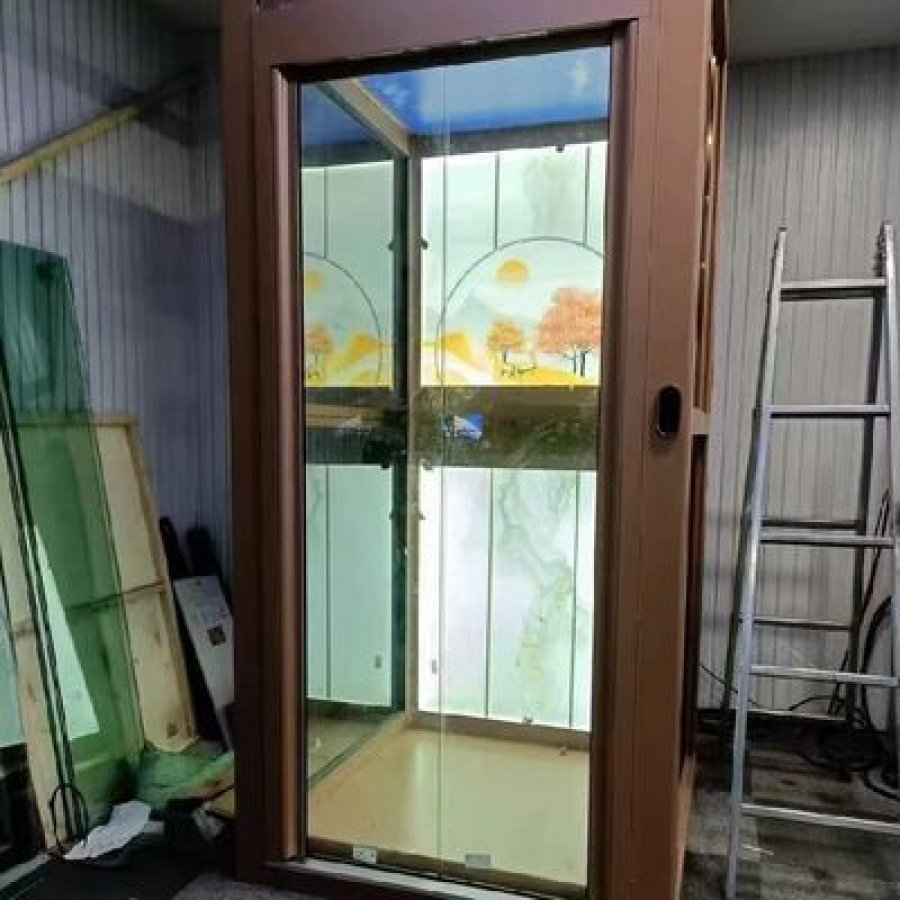
Stainless-Cabin Hydraulic Home Elevator – 14.5 m, 5 Stops
Product Details:
Brand Name
YIMEISITE
Place of Origin
China
Payment & Shipping Terms:
Minimum Order Quantity
1 set
Price
USD 4,000-10,000 per set
Payment Terms
T/T,L/C
Supply Ability
20 sets per month
Delivery Time
45 working days
Packaging Details
Export non-fumigation wood box
| Cabin: | 304# Stainless Steel/aluminium Alloy | Max Height: | 14.5 M |
| Warranty: | 1 Year | Door Type: | Automatic |
| Overhead Clearance: | 3m | Motor: | 4.7 Kw |
| Number Of Stops: | 5 | Power Supply: | Single-phase AC |
| Highlight: | Stainless Cabin Home Lift Hydraulic,Home Lift Hydraulic 14.5 Meter,14.5 Meter Small Residential Elevator | ||
Product Description
Hydraulic home elevator · stainless steel or aluminium cabin
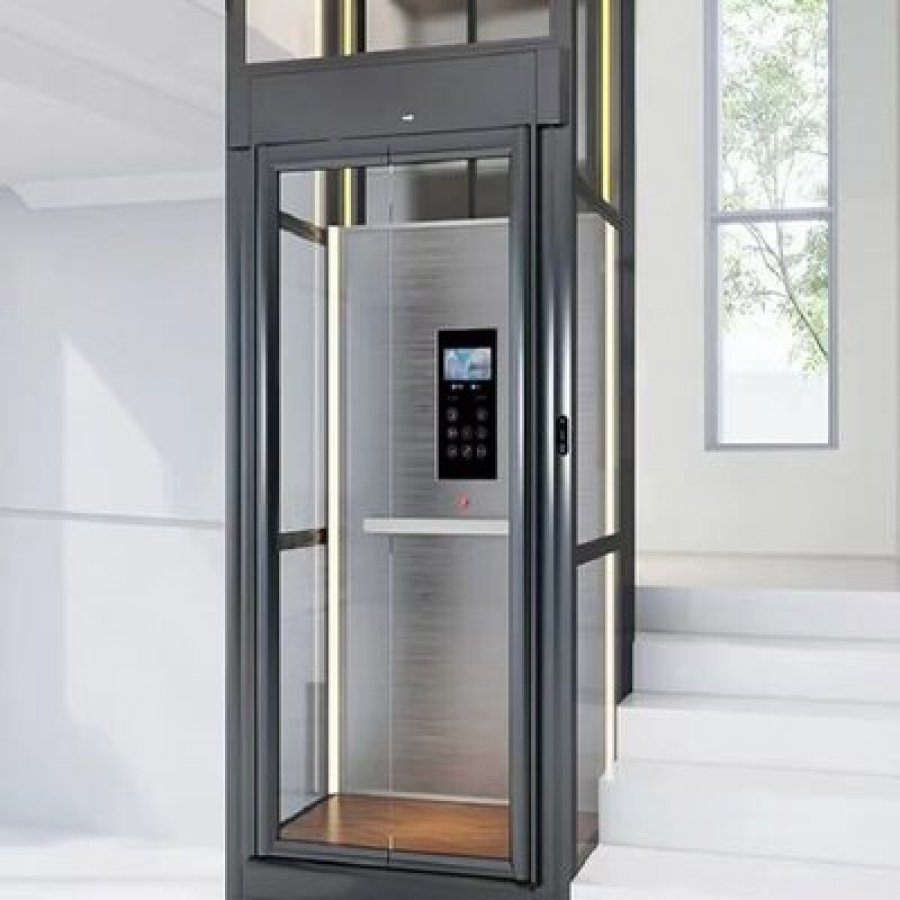
A stainless cabin hydraulic home elevator is bought on the cabin line first and the machine second — because the cabin is the part you touch, clean and look at every day.
This page is about one model in that family: a pitless hydraulic home elevator with 14.5 m of travel, 5 stops, 0 m pit depth and 3 m overhead clearance, carrying a cabin in 304# stainless steel or aluminium alloy, driven by 2.9 m large hydraulic cylinders and a 4.7 kW motor on a 220 V, 50 Hz single-phase supply, with microprocessor control, automatic doors and a twelve-month warranty. Every figure is read off this product's own specification tables; where those tables are silent, the text says so. Most enquiries for this lift turn out to be a materials question, because two buyers can order the same machine and end up with two very different cabins, cleaning routines and bills — so the centre of this page is how to choose the cabin material, with the machine, the installation conditions and the maintenance routine following from there.
This model at a glance
- Drive and travel: pitless hydraulic, travel up to 14.5 m over 5 stops, with 0 m pit depth and a listed 3 m overhead clearance.
- Cabin: the table lists 304# stainless steel or aluminium alloy. That is the choice this page is built around — both skins are offered on this machine, and they behave differently.
- Machine: 4.7 kW motor, 2.9 m large hydraulic cylinders, microprocessor control, 220 V / 50 Hz single-phase AC, automatic doors, emergency stop button and hydraulic safety set, deck floor, 12-month warranty.
- Commercial terms on the same sheet: brand YIMEISITE, origin China, minimum order quantity 1 set, USD 4,000–10,000 per set, T/T or L/C at sight, supply ability 20 sets per month, 45 working days, non-fumigation wood box.
- Not stated here, and therefore not claimed: rated load, travel speed, shaft and cabin dimensions, noise level, and any certification or standard number.
The short version. This lift suits a house or low-rise building where the run is up to 14.5 m and five stops, where digging a pit is impossible or undesirable, and where single-phase power is what is available. The cabin line is where the money and the maintenance go: 304 stainless steel is the harder-wearing, easier-to-clean option, aluminium alloy the lighter and more shape-flexible one, and glazing is bought for light. Sections 2 and 3 decide the cabin; sections 4 and 5 decide whether the site works.
1. Whether this lift fits your building
Start with the three numbers that decide almost everything on a hydraulic home lift: how far it has to travel, how deep a pit you are willing to dig, and how much headroom you have above the top landing. On this model the published answers are 14.5 m of travel across 5 stops, a 0 m pit depth, and 3 m of overhead clearance.
Read together, those three figures describe a particular kind of building: a property where the lift has to reach four or five levels, where there is no appetite for breaking a floor slab or casting a well, and where the ceiling above the top stop can give up about three metres.
The short answer
If your run is within 14.5 m, your top landing has the listed 3 m overhead, and you can bring 220 V single-phase power to the machine, this configuration is normally workable. If any one of those three does not hold, the honest answer is that you are looking at a different machine rather than a different set of options on this one. The hydraulic home elevator range carries the neighbouring configurations — including a single-phase model with microprocessor control and a 5-stop pitless unit with automatic doors — and it is worth reading those pages side by side with this one before the layout is fixed.
A good fit
- Four or five levels in a house. 14.5 m of travel over 5 stops is enough for a tall villa, a house on a slope, or a building where the lift also serves a lower ground floor.
- Renovation with no room for a well. A 0 m pit depth means there is nothing to excavate under the lowest floor. On refurbishment work that is usually the difference between a lift and no lift.
- Sites with single-phase power only. A domestic supply is often 220 V single-phase. This model is built for that, which removes the cost of a three-phase upgrade.
- Owners who clean the cabin themselves. Both listed cabin materials — 304 stainless steel and aluminium alloy — are cleanable without specialist products.
A poor fit
- A run longer than the published travel. 14.5 m and 5 stops are the numbers on this page. If you need more, this is the wrong table to be reading.
- Less than the listed overhead. The sheet asks for 3 m above the top stop. Take that away and there is no honest way to install the machine as specified.
- High-traffic vertical transport. A hydraulic home lift is a domestic machine. A hotel or a busy commercial building needs a different duty cycle, and this page publishes nothing that would support one.
Settle before you order
- The hoistway or shaft plan. The shaft, cabin and door dimensions are not on this sheet. They are set per project, and they are the first thing a fitter will ask for.
- The rated load, in writing. One person plus a wheelchair, or a small goods load, are different machine settings, and the figure has to come from the factory rather than from an assumption.
- Which floors the five stops serve. Five stops is a count, not a layout. Landing positions decide the cylinder arrangement and the door positions.
- Who maintains the hydraulic side. Oil, seals and the safety valve group eventually need attention. Ask who does that in your area before you buy, not after.
2. Choosing the cabin material on this stainless cabin home lift
The specification table on this page lists the cabin as 304# stainless steel or aluminium alloy. Those are two different skins on the same machine, and the difference shows up in three places buyers notice: how the cabin looks when it is installed, how it looks after years of hands and cleaning cloths, and what the cleaning takes out of your week.
The machine behind the cabin is common to both options, so the cabin question can be settled on its own:
- Shared by both skins: hydraulic drive, 14.5 m travel, 5 stops, 0 m pit, 3 m overhead clearance.
- Shared electrical package: 4.7 kW motor on a 220 V, 50 Hz single-phase supply, microprocessor control and automatic doors.
- Open to either skin: a closed cabin in metal, or the same structure carrying glazed panels.
What the cabin actually decides
A lift cabin is a box inside a shaft. Everything a passenger experiences — light, sound, the sense of space, the visibility of a fingerprint — comes from that box rather than from the drive. It also decides a large part of the maintenance routine, because the three surfaces require three different habits. Section 5 covers those habits in detail.
Option one
304 stainless steel cabin
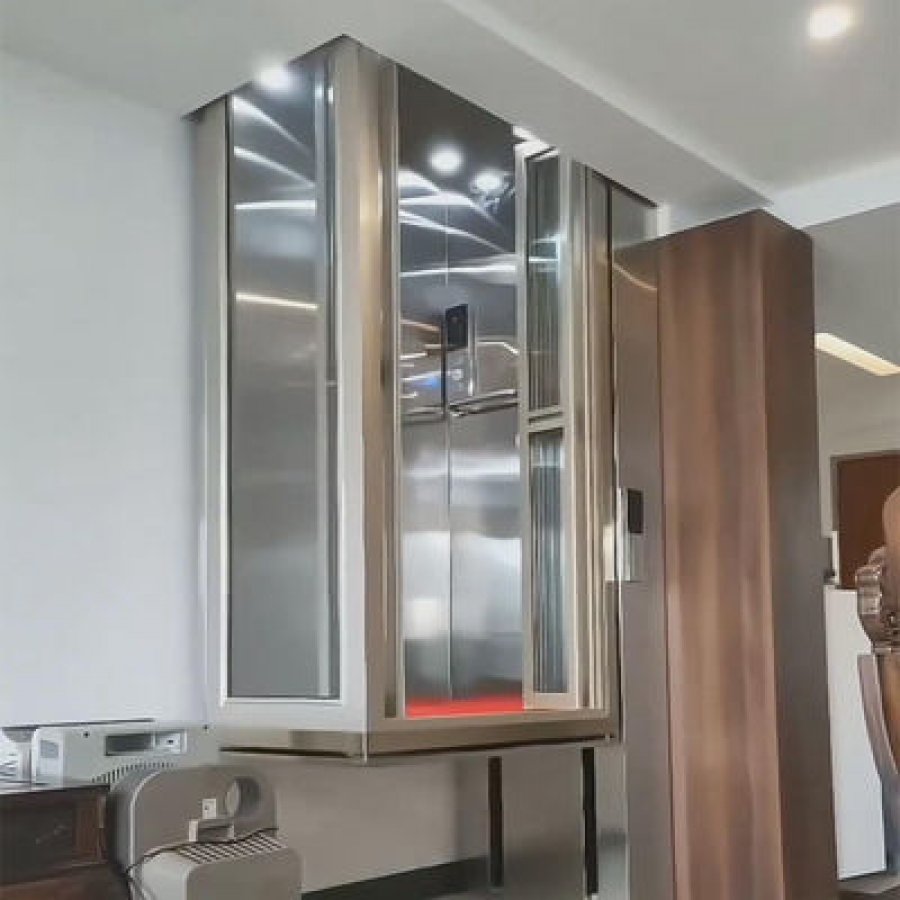
The default for a lift that has to look after itself. 304 is the stainless grade used for kitchen and sanitary equipment — a fair guide to how it behaves: it tolerates everyday cleaning, needs no protective coating, and takes a brushed or mirror finish.
- Cleaning: warm water, a soft cloth and a mild household cleaner are enough.
- Scuffs: a brushed finish breaks up mild marks; a mirror finish shows every one of them.
- Where it wins: busy households, damp locations, and cabins used daily.
If your search was for a 304 stainless steel home elevator, this is the cabin question seen from the grade side: read 304 stainless steel cabin hydraulic home elevator.
Option two
Aluminium alloy cabin
The lighter of the two skins, and the easier one to shape and colour. An aluminium alloy cabin can carry profiles, trims and coloured finishes that a flat stainless panel cannot, which is why it suits cabins that must match an interior scheme.
- Cleaning: straightforward, but finishes vary — check what the surface coating is before choosing an abrasive cleaner.
- Scuffs: a coated or anodised surface resists light marking; a deep scratch is harder to disguise than on brushed stainless.
- Where it wins: interiors that must match a colour scheme, and structures where cabin weight matters.
The aluminium frame approach in a panoramic cabin is shown on panoramic pitless home elevator with an aluminium frame.
Option three
Mixed cabin with glazing
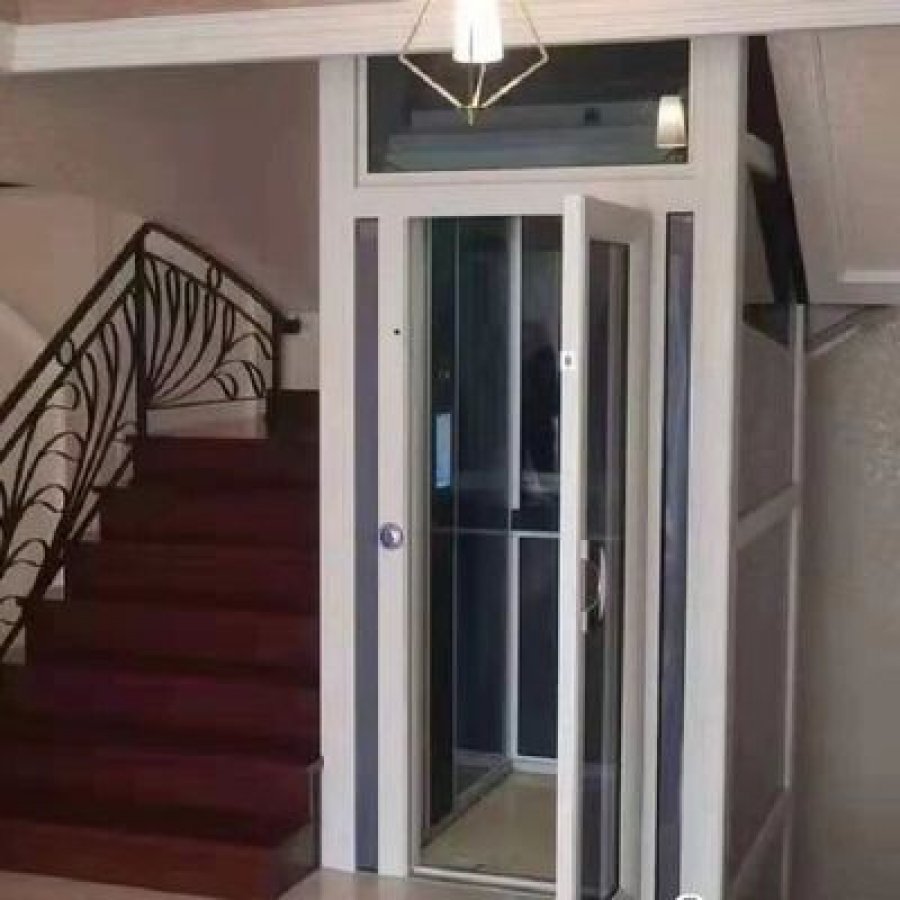
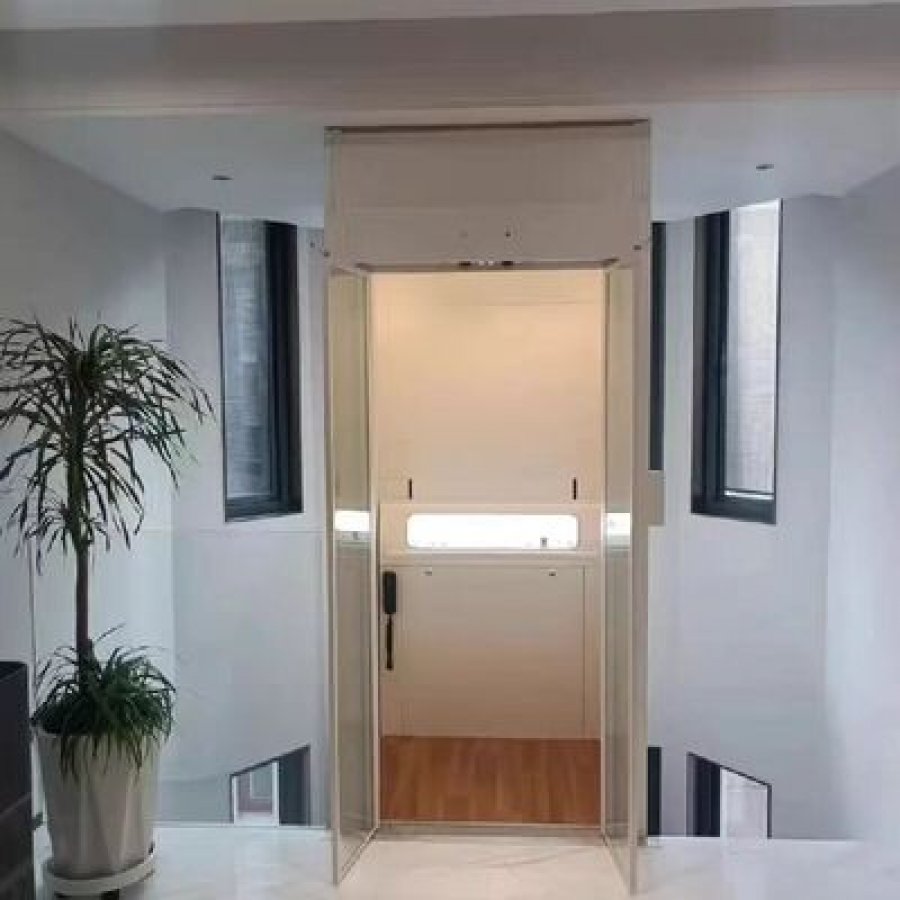
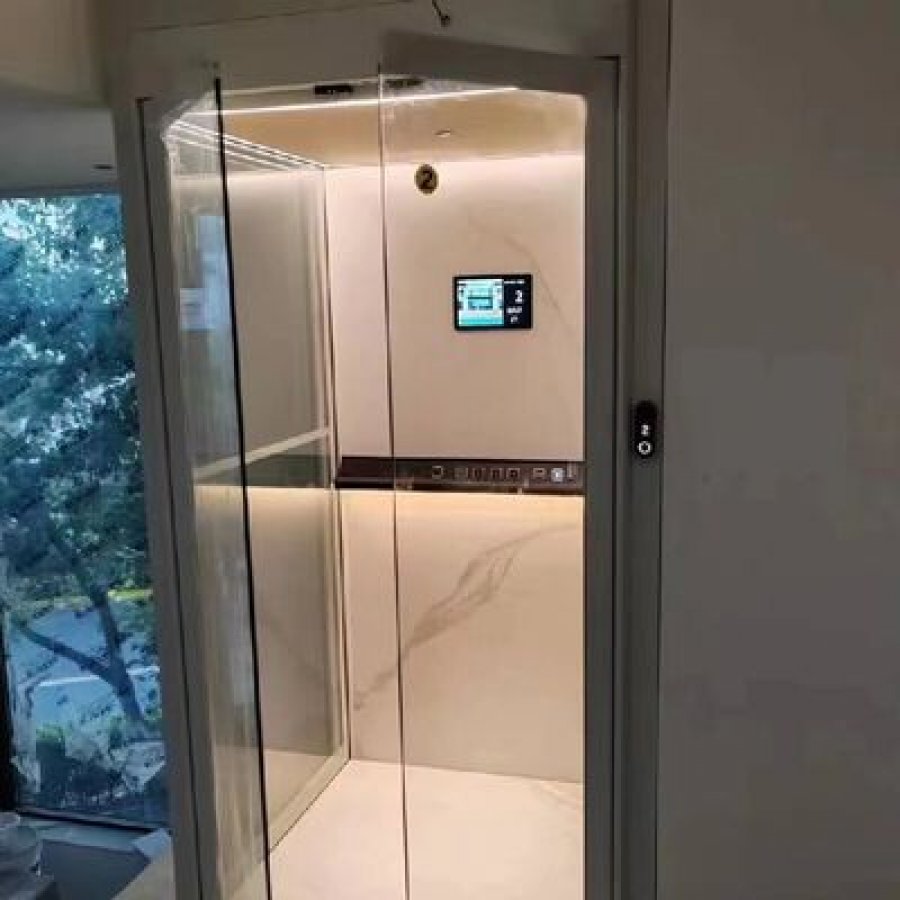
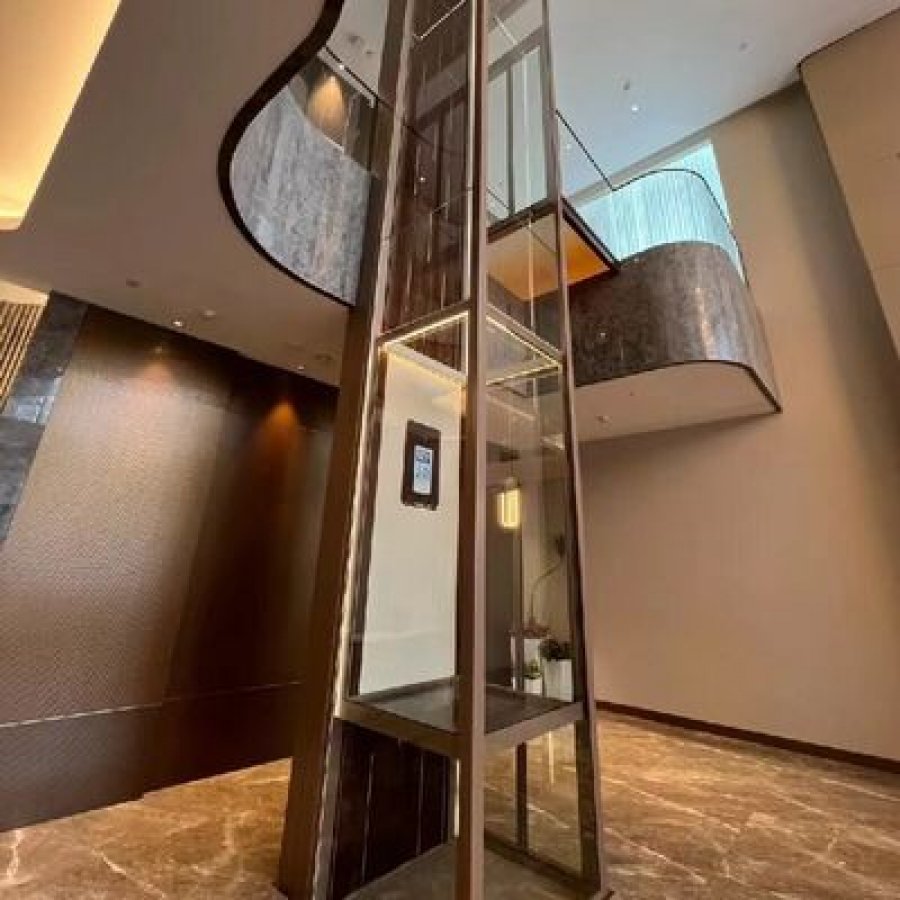
This page's own description notes glass cabins combined with stainless cabins, so a mixed cabin — metal structure with glazed panels — is a real configuration rather than an afterthought. Glazing is bought for light, not for toughness.
- Cleaning: the highest of the three. Glass shows fingerprints and dust that metal would hide.
- Scuffs: glass scratches are permanent, so grit has to be lifted off rather than wiped around.
- Where it wins: stairwells and living areas where a solid box would feel like a blockage.
Glass-led cabins are documented on glass home elevator with a quiet hydraulic drive. If glazing is the main reason you are here, start there.
The three skins side by side
The table below compares the three options on the points that decide a residential purchase.
| Cabin skin | Cleaning effort | How it ages | Light in the shaft | Read next |
|---|---|---|---|---|
| 304 stainless steel | Lowest. Water, soft cloth, mild cleaner. | Brushed hides mild marks; mirror shows them. No coating to wear through. | None on its own; a solid, closed cabin. | 304 cabin model |
| Aluminium alloy | Low, but finish-dependent. | Coated and anodised surfaces wear; deep scratches are hard to disguise. | None on its own, unless the frame carries glazing. | Aluminium frame model |
| Mixed cabin with glazing | Highest. Glazed panels are cleaned more often. | Glass is dimensionally stable but scratch marks are permanent. | The most — the reason to choose it. | Glass cabin model |
Switch between the three cabin options
304 stainless steel — the low-maintenance default
Choose it when the lift will be in daily use by a household and you would rather not think about the cabin again. It takes a brushed finish that absorbs everyday marks, or a mirror finish for a sharper interior. The finish you specify is what you will be cleaning for the life of the lift.
Aluminium alloy — shape, colour and weight
Choose it when the cabin has to follow a colour scheme or when the structure is sensitive to cabin weight. Aluminium alloy gives profiles and colours a flat stainless panel cannot, and it is the lighter of the two listed skins. The trade-off is a surface that depends on its coating: ask what the finish is, and clean it as that finish requires rather than as stainless steel.
Mixed cabin with glazing — light first
Choose it when the shaft sits against a room that would otherwise lose its light, or in a stairwell where a solid box would read as a blockage. Glazing is the reason to choose this option, and the trade is a surface that needs cleaning more often. Section 5 explains why grit has to be lifted rather than wiped.
Four questions settle it:
- Used daily by children and guests? 304 stainless steel with a brushed finish needs the least attention.
- Must the cabin match a colour or a shape? Aluminium alloy is the flexible skin.
- Does the shaft run past a living area? If a solid box would be oppressive, choose glazing.
- Is the property near water, salt air or a humid climate? Then the grade matters more than the finish — read the 304 stainless steel hydraulic model.
One caution about material names. “Stainless” and “aluminium” are families, not single materials, and two suppliers can both write “stainless cabin” while delivering different grades. This page's table states 304# stainless steel or aluminium alloy, and that is the statement to hold a supplier to in writing.
3. Specification, in metric and imperial units
Everything below is transcribed from this product's own specification tables. Nothing has been carried over from a neighbouring model, and nothing has been converted from a figure that is not on the page. Switch the units to see the same values in imperial measure.
If you arrived looking for a 14.5 m home elevator, this table is the whole of the machine: travel, stops, pit, headroom, cabin, cylinders, motor, supply, control and doors.
Units
Metres and kilowatts on one side, feet, inches and horsepower on the other. The values are the same facts; only the units change.
| Item | Listed value | What it decides |
|---|---|---|
| Drive type | Pitless hydraulic | No well under the lowest landing, and no machine room over the shaft. |
| Maximum travel height | 14.5 m 47 ft 7 in | Total floor-to-floor distance the car can cover across all stops. |
| Number of stops | 5 | How many landings the lift serves, including the lowest and the highest. |
| Pit depth | 0 m 0 ft | Nothing to excavate below the lowest floor level. |
| Overhead clearance | 3 m 9 ft 10 in | The headroom the shaft has to give above the top landing. |
| Cabin material | 304# stainless steel / aluminium alloy | The material question this page is built around — see section 2. |
| Cylinders | 2.9 m length, large hydraulic cylinders 9 ft 6 in length, large hydraulic cylinders | The hydraulic elements that lift the car; the specification lists them as large, 2.9 m long. |
| Motor power | 4.7 kW 6.3 hp | The size of the pump motor, and part of what your electrician has to allow for. |
| Power supply | 220 V, 50 Hz, single-phase AC | A domestic supply, not a three-phase industrial one. |
| Control system | Microprocessor | Levelling at the landing and the fault reporting a service technician reads. |
| Door type | Automatic | Doors open and close without the passenger handling them. |
| Floor type | Deck floor | The cabin floor surface listed for this model. |
| Safety | Emergency stop button, hydraulic safety set | Manual emergency stop plus the hydraulic valve group that governs descent. |
| Warranty | 12 months (listed as 1 year) | The stated warranty term for this model. |
Source: this product's specification tables, read on the page you are on. Nothing in this table is estimated, interpolated or copied from another model.
Where each figure comes from
The specification appears twice on this page, in two different shapes: a short commercial table and a longer feature table. The two agree on every value that appears in both. Where they differ in wording — the warranty is written both as “1 Year” and as “12 months” — the meaning is the same and the table above keeps both spellings visible.
That matters because a lift is bought against a document. If a supplier quotes a travel height, a pit depth or a motor power that is not written here, ask for the source of the difference before you sign rather than after.
Two things this table deliberately does not say
The rated load is not stated. There is no load figure in either specification table. That is a real gap: the rated load decides how many people the cabin may carry, what the overload protection is set to, and whether a wheelchair user plus a carer is within the design. It is not guessed here: ask our engineers for the figure.
The travel speed is not stated either. A hydraulic home lift runs at a domestic speed, but this page does not publish the figure, so none is quoted here. If speed is a deciding factor, ask for it in writing with the quotation.
Two further items belong on the same list: the shaft, cabin and door dimensions, which are set per project, and any certification or standard the machine is delivered against.
What to check on the drawing, not on this page
Four numbers decide whether a hydraulic home elevator actually fits, and none can be read off a catalogue page: the internal clear size of the shaft, the cabin outline it will accept, the door opening at each landing, and the position of the pump unit. Those come back on a project drawing after you supply the shaft plan — section 8 lists the whole set.
About the cylinders and the travel. The specification lists 2.9 m long large hydraulic cylinders and, separately, a maximum travel of 14.5 m. This page does not describe the ram arrangement that produces that travel, so this document does not explain or derive it. Both figures are quoted as listed; the arrangement is an open item to confirm with the factory if it affects your shaft design.
4. Pit, headroom and power: the three conditions
A pitless hydraulic home elevator is bought for one reason above all others: it removes the excavation. On this model the pit depth is listed as 0 m, so the car travels down to the lowest floor level instead of into a well below it. In a completed building, or a house where the ground floor is a slab on grade, that single figure often decides whether the project is possible at all.
In short, this is a 5 stop hydraulic home elevator whose whole appeal is the absence of a well. Removing the pit does not remove the conditions, though — it moves them. The machine still needs somewhere for the pump unit, the shaft still needs headroom above the top landing, and the power still has to reach the machine.
1. Overhead clearance — 3 m
The specification lists 3 m of overhead clearance. That is the clear height the shaft has to provide above the top landing, and it is the condition most often discovered late, because it is set by the building rather than by the lift.
What 0 m pit depth actually means
A conventional hydraulic lift descends into a pit: a lined depression below the lowest landing. This model's table states 0 m, so the lowest landing is also the lowest point the car reaches. The practical consequences are worth spelling out, because “pitless” is often read as “no site work”:
- No excavation, no water table problem, no drainage. In a basement or on a slab, this is usually the deciding advantage.
- The lowest floor stays flat. There is no well to detail around, which simplifies flooring and thresholds.
- Site work does not disappear. The shaft still needs a defined structure, the lands still need door openings, and the pump unit still needs to sit somewhere with a route for the oil line to the cylinders.
Overhead clearance: the 3 m condition
The listed 3 m of overhead clearance is the clear height above the top stop. It is there for the machine, not for the passengers: the car has to reach the top landing with the drive system above it, and a technician has to be able to work on the equipment.
If your top landing sits under a shallow ceiling, in a converted attic, or under a roof structure you cannot alter, measure this figure first. Where the 3 m is not available, the decision is normally to move the top stop down one level rather than to argue with the number.
Power, wiring and the 4.7 kW single-phase motor
The listed electrical conditions are 220 V, 50 Hz, single-phase AC with a 4.7 kW motor (≈ 6.3 hp) — the supply a house normally already has, which is why this lift can go in without a three-phase service upgrade. Three things are still worth settling with your electrician before installation:
- A dedicated circuit from the distribution board to the machine position, sized for the listed motor.
- Where the supply lands. The pump unit position decides this, and the pump unit position is chosen when the shaft is laid out.
- Frequency and voltage of your supply. The listed condition is 50 Hz. If your building runs a different frequency or voltage, say so at enquiry stage — this page describes one electrical configuration, not a range.
Not published on this page: the running current, the starting current, the recommended cable size and the type of protective device. Those are electrical design figures, they do not appear in either specification table here, and they should come from the factory with the quotation rather than from a supplier's estimate.
Cylinders, and where the pump unit goes
The specification lists 2.9 m long large hydraulic cylinders and a pump unit driven by the 4.7 kW motor. The page does not describe how the cylinders are arranged to produce 14.5 m of travel, so treat the ram arrangement as a drawing-level question for the confirmation drawing. The pump unit is the part with a footprint in the building: it needs to sit where a technician can reach it, where the oil line runs sensibly to the cylinders, and where its noise is acceptable on the other side of the wall. That location is normally chosen during the survey.
Site self-check before you request a quote0 of 3
Three ticks and this configuration is very likely workable. Two or fewer, and it is worth a conversation before the shaft is built.
How the installation actually runs
From the published terms on this page, the sequence below is what a project looks like.
Step one
Survey and measurement
Shaft plan, floor-to-floor heights, the 3 m overhead, the door positions at each landing and the planned pump unit position. This is where a project is either confirmed or adjusted, and it costs nothing to do properly.
Step two
Confirmation drawing
The cabin outline, door arrangement, cylinder arrangement and shaft interfaces come back as a drawing. Check the cabin material line against what you ordered — 304 stainless steel and aluminium alloy are not interchangeable words.
Step three
Manufacture
The published delivery time is 45 working days, with a minimum order quantity of 1 set. Doors, cabin and hydraulic package are produced against the confirmation drawing.
Step four
Packing and shipping
Export non-fumigation wood box is the listed packing, with T/T or L/C at sight and a published supply ability of 20 sets per month.
On site — your side
Structure, opening and power ready before the crew arrives
There is no pit to dig. What remains is the shaft structure and door openings, a level floor at the lowest landing, the 220 V single-phase circuit and access for the crate. Sequencing these before the delivery date keeps an installation to days rather than weeks.
Step five
Installation, levelling and handover
The car is assembled in the shaft, the cylinders and safety set are connected, and the control is levelled at every landing. Handover is when the 12-month warranty starts, so ask for the commissioning record and keep it with the warranty documents.
5. Cleaning and maintenance, by cabin material
Maintenance on a hydraulic home elevator splits into two jobs. One is the cabin: cosmetic, weekly, and done by whoever lives in the house. The other is the machine: periodic, technical, and done by someone who knows what a hydraulic safety set is meant to do.
The five-minute weekly routine
Whichever skin you chose, the same order of operations keeps it presentable. Doing it in this order matters more than the products you use.
- Dust first, wipe second. Wiping a dusty panel moves grit across the surface, and grit is what leaves fine scratches. A dry microfibre cloth first, a damp one second.
- Use the mildest thing that works. Warm water with a little mild household detergent handles almost everything on a cabin wall.
- Clean the high-touch zone. Handrails, door edges, call buttons and the panel beside the door collect more marks than the walls, and they are what a guest notices.
- Dry the surface. Water left to dry leaves mineral spotting on metal and streaks on glass. A second dry pass removes both.
304 stainless steel: brushed and mirror finishes
Stainless steel is chosen for a reason no other skin matches: it does not depend on a coating to stay presentable, so there is no layer to wear through. The finish is what changes the routine, and it is where most cabin complaints originate:
- Brushed finish — the practical choice. Light marks blend into the grain and can often be removed by working along the direction of the grain with a non-scratching pad.
- Mirror finish — the sharpest look and the highest upkeep. It shows every fingerprint, so it needs a dedicated stainless cleaner and a frequent wipe rather than a weekly one.
- Never clean along the wrong axis. On a brushed panel, wiping across the grain leaves visible lines. Wipe with it.
- Avoid chloride-heavy cleaners. Bleach-based and aggressive bathroom products are the wrong choice for stainless steel — the one rule worth writing inside a cupboard door.
If grade rather than finish is your question, the 304 stainless steel cabin model covers the difference between grades and the coastal case in detail.
Aluminium alloy: what to avoid
Aluminium alloy is the lighter skin and the one that carries colour, profiles and shaped panels. Its weakness is surface hardness: an unprotected aluminium surface marks more easily than stainless steel, which is why practically every aluminium cabin is supplied with a coating or an anodised layer. That single fact sets the cleaning rules.
- Ask what the finish is, then clean for that finish. A powder-coated panel and an anodised panel tolerate different products.
- No abrasive pads and no scouring cream. They cut through the surface layer, and once it is gone it cannot be restored by polishing the way stainless can.
Glazed panels: lift the grit, do not wipe it
Glass is the least forgiving surface in a cabin, and not because it is fragile. It is because a scratch in glass is permanent, while a scratch in metal can often be blended out.
- Rinse or lift the dust off before touching the surface with a cloth. Dry-wiping a dusty pane is the single most common way a glass cabin gets marked.
- Use a glass cleaner and a clean, non-linting cloth. Work in an overlapping pattern, finish the edges last.
The hydraulic side: oil, cylinders and the safety set
A hydraulic home lift is driven by oil pushed from a pump into cylinders, with a valve group controlling the descent. The listed safety equipment is the hydraulic safety set, and it decides how the car behaves if pressure is lost. No owner should maintain that personally; what an owner can do is notice changes early.
- Watch for oil at the cylinder area. Any wet film where there should be none is worth a service call, not a wait-and-see.
- Listen for change. A new noise, a judder at one landing or slower levelling is the machine telling you something. Describe it in those terms when you call.
- Keep the pump area clear and ventilated, and do not top up oil yourself — the correct oil and level belong to the machine's specification, and this page publishes neither.
Cabin skin — weekly
Dry dust, then a damp cloth with mild detergent, then dry. Match the method to the finish: brushed stainless along the grain, mirror stainless with a dedicated cleaner, coated aluminium without abrasives, glazing with the grit lifted first.
Doors and floor — weekly
Vacuum the sill and track, check the automatic doors run without drag, and keep the landing floor free of grit. Door detection is a safety device, not a convenience — if a door starts closing on people or objects, stop using the lift until it is checked. Keep liquids off the deck floor, and know where the emergency stop button is before you need it.
Hydraulic machine — by a technician
Oil, seals, the safety set and the control panel belong to a trained service visit. This page publishes no service interval, so agree one at handover and record it.
What the 12-month warranty does — and what this page does not say
The specification states a warranty of 12 months, written in one table as “1 year”. That is the only warranty figure on this page.
One habit worth building. Ask any supplier of this machine three things in writing before the lift is in the shaft: which cabin material and finish is actually being supplied and how it should be cleaned; what the 12-month warranty covers item by item and what happens in year two; and who services the hydraulic side in your region.
6. Where a 14.5 m five-stop hydraulic home lift is used
The configuration on this page — five stops, 14.5 m of travel, no pit, three metres of overhead, a single-phase 4.7 kW machine — turns up in a recognisable set of buildings. Recognising your own project in one of them is the quickest way to know whether the rest of this page applies to you.
A tall house, including one built on a slope
Four or five levels on a single plot is exactly the shape this machine was specified for. On a hillside property the lift often also serves a lower ground floor cut into the slope, which is where five stops rather than four becomes useful and where the 0 m pit matters most, because that floor is usually a finished slab.
Watch: the overhead above the top landing is the figure that decides whether all five stops fit.
A retrofit in a finished building
This is the classic case for a pitless hydraulic lift. The floors are already laid, the ground floor is already a slab, and breaking it up to cast a well is neither cheap nor welcome. A 0 m pit depth removes that whole problem and the lift descends to floor level instead.
Watch: the shaft structure and door openings still have to be built, and the pump unit still needs a home.
A shaft beside a stairwell or living area
Where the lift stands next to the stairs or opens into a living space, a solid metal box can read as a blockage. A mixed cabin with glazed panels is the normal answer on this model — this page's own description notes glass cabins combined with stainless structures — and it is a decision to make before the cabin is ordered rather than after.
Watch: cleaning effort. Glazing is bought for light and paid for in fingerprints.
A multi-generation household
A lift that a grandparent uses daily with a grandchild in the cabin changes the priorities: the cabin needs to be cleanable in minutes, and the machine needs predictable behaviour rather than speed. A 304 stainless steel cabin with a brushed finish is the straightforward choice.
Watch: the rated load. It is not stated on this page, and it is the figure that decides how many people the cabin may carry.
A house where the lift has to match the interior
Where an architect has fixed a palette, an aluminium alloy cabin carries colours, profiles and shaped panels that a flat stainless wall cannot, while a brushed stainless cabin answers the same brief in a cooler register. Both are listed for this machine.
Watch: the finish definition. “Stainless” and “aluminium” are families, not single materials.
What these settings have in common
Every one of them is a low-rise building where the constraint comes from the structure rather than the traffic: none needs speed, and all need the machine to fit a building that already exists. The reverse is also true — an application that needs a faster machine, a much heavier load or a longer run is not a better-configured version of this lift, it is a different product.
Comparing this lift with its neighbours
Three pages are worth reading alongside this one:
- 304 stainless steel cabin, pitless, 5 stops — start here if the question is which stainless grade, including how to think about damp and coastal locations.
- Panoramic pitless lift with an aluminium frame — start here if the question is how much glazing rather than which metal.
- Single-phase hydraulic home elevator with microprocessor control — start here if the electrical supply is your main constraint and you want to see how the single-phase case is handled elsewhere in the range.
All three are the same machine seen through a different decision.
7. Hydraulic home elevator FAQ
These are the questions that come up in enquiries for this machine, in roughly the order they are asked. Every answer is tied to what this page states, and where the page is silent the answer says so.
It is a hydraulic home elevator — a car driven by oil pushed from a pump into cylinders — whose cabin is built from stainless steel rather than from painted steel, glass or timber. The stainless part describes the box you stand in; the hydraulic part describes how it moves.
On this model the specification lists the cabin as 304# stainless steel or aluminium alloy, so the stainless cabin is one of two skins on the same machine. The rest of the machine is listed as pitless hydraulic drive, 14.5 m travel, 5 stops, 0 m pit depth, 3 m overhead clearance, 4.7 kW motor on a 220 V 50 Hz single-phase supply, microprocessor control and automatic doors.
The published price band for this model is stated in the commercial terms on this page as USD 4,000–10,000 per set, with a minimum order quantity of 1 set. That band covers the equipment as specified here; it is not a delivered or installed price, and it does not include site work, customs, freight or installation labour.
Within the band, the cabin line is usually the largest single driver — material, finish, glazing and the size of the box. Then come travel height and stops, the door arrangement at each landing, and anything non-standard in the shaft. For a figure you can plan against, use the list in section 8.
A fair list, without the marketing:
- The pump unit takes space and can be heard. There is a machine to house, and its position has to be chosen with noise and access in mind.
- There is oil in the system. Oil, seals and the cylinder area are long-term maintenance items a traction lift does not have in the same form.
- Travel speed is domestic, and this page does not publish it.
Against that, the advantages are the ones the specification is built on: no pit, no machine room above the shaft, gentle travel, and a supply a normal house already has.
This page does not state a design life, and no number is invented here to fill the gap. What determines it is straightforward: the cabin and structure are largely inert, while the hydraulic package and the door mechanism are not. Oil condition, seal life, daily trips and whether the machine sits in a clean dry place all move the answer.
So the useful version of this question is not “how many years” but “what is the service schedule, and who performs it here”. The listed warranty term is 12 months; what happens in year two is a commercial term to agree in writing.
Yes — pitless is what this model is specified as. The drive type is listed as pitless hydraulic and the pit depth as 0 m, so there is no well to excavate below the lowest landing.
What pitless does not mean is that the site is unprepared. The trade is a pit for headroom: this model asks for 3 m of overhead clearance above the top stop, and the shaft structure, door openings and a place for the pump unit still have to be provided. In a finished building that is the better trade, because a shaft can be framed in the space available while a pit cannot be conjured under an existing floor.
That is the design case. The specification lists 220 V, 50 Hz, single-phase AC with a 4.7 kW motor — roughly 6.3 hp — which is why this lift can go into a house without converting the service to three-phase. Give it its own protected circuit sized for the listed motor, and raise it at enquiry stage if your building runs a different voltage or frequency, because this page describes one electrical configuration and not a range.
The running current, starting current and recommended protective device are not published here. Ask for them with the quotation — your electrician needs them before the circuit is run.
Not in the brushed finish, which is the version most buyers choose. A dry dust followed by a damp cloth with a little mild detergent handles a domestic cabin in minutes, and because stainless steel has no coating to wear through, the surface does not degrade as it is cleaned.
The exception is a mirror finish: the same material with a far more demanding surface, needing a dedicated stainless cleaner and more frequent attention. Avoid chloride-heavy cleaners, and wipe along the grain on a brushed panel rather than across it.
The phrase turns up when buyers compare hydraulic travel limits, and it is used differently by different people. This page does not define it and states no jack-stroke or travel-to-stroke ratio, so no ratio is claimed here.
What this page does state are the limits you can design against: 14.5 m of travel across 5 stops, a 0 m pit and 3 m of overhead clearance, with the cylinders listed as 2.9 m long and large. If a supplier cites a rule of that kind, ask them to write it down against the cylinder arrangement on your confirmation drawing. A rule you cannot see applied to your own shaft is not a specification.
It depends on the rated load and on the cabin and door opening at your landings, and this page does not state any of those figures. That makes a wheelchair requirement a confirmation question rather than a reading exercise: the rated load has to cover the chair plus a carer, and the door opening and cabin size have to let the chair turn or reverse as your users need. Both stay open: ask our engineers rather than assuming them.
8. What to send for a quotation
The specification on this page answers the machine question. What it cannot answer is your building. These eight items are what turns a catalogue page into a configuration, and all of them come from a site visit or a shaft drawing rather than from a preference.
Tick what you already have. Whatever is still unticked is the list of things to measure before the enquiry goes out — and it is also the list of things that, if left unmeasured, come back as a change order later.
Quotation checklist0 of 8
Eight items, one exchange. With these, a supplier can come back with a configured machine — cabin material, dimensions, door layout, hydraulic package and electrical requirements — not a brochure.
What comes back
A complete answer should return four things: a drawing of the cabin and shaft interfaces, the rated load and travel confirmed in writing, the cylinder and pump unit arrangement for your layout, and the electrical figures your electrician asked for.
If you are still comparing drive types, the pages worth your time are the hydraulic home elevator range and, for the grade question behind the cabin, the 304 stainless steel hydraulic model.
Send the shaft, the heights and the supply — get a configured lift, not a band
This model is a pitless hydraulic home elevator with 14.5 m of travel, 5 stops, a 0 m pit, 3 m of overhead clearance and a cabin in 304# stainless steel or aluminium alloy. Tell us the building and the cabin you want, and the specification above stops being a catalogue entry and starts being your project.
Use the eight-point checklist See the hydraulic home lift range
Stainless cabin hydraulic home elevator · 14.5 m · 5 stops · 0 m pit · 304 or aluminium cabin
Want to Know more details about this product
Similar Products