English
 Español
Categories
Contacts
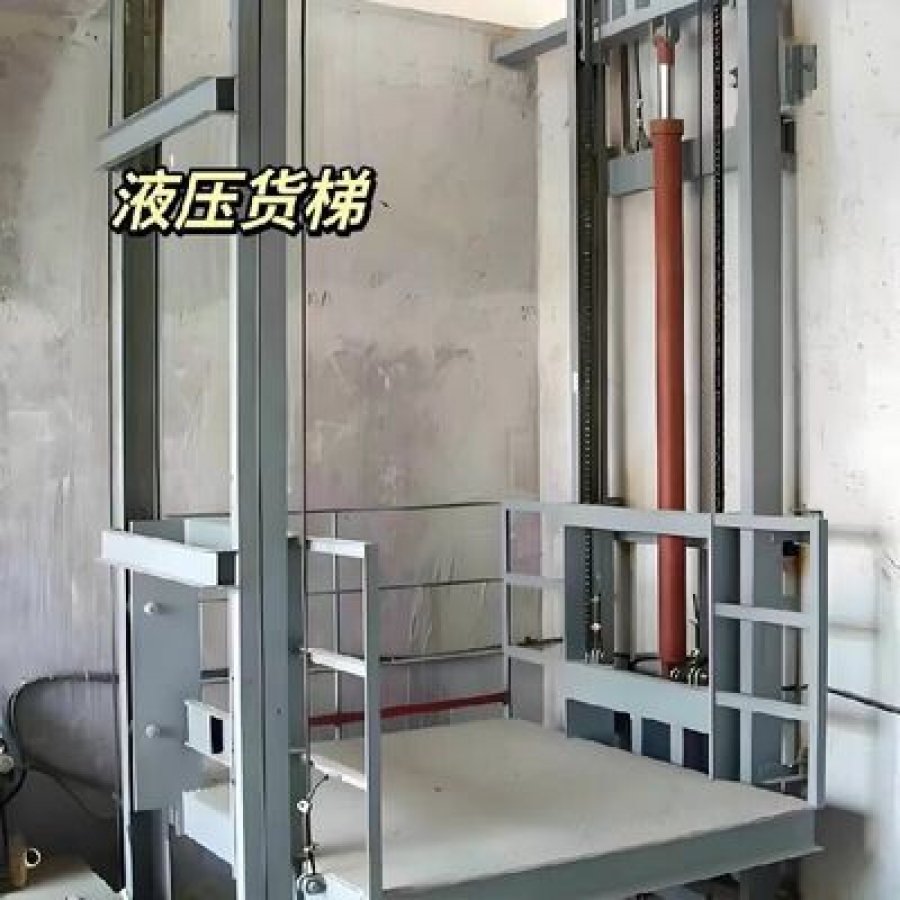
1–2 Ton Hydraulic Cargo Lift with PLC Control
Product Details:
Brand Name
YIMEISITE
Place of Origin
China
Payment & Shipping Terms:
Minimum Order Quantity
1 set
Price
USD 4,000-10,000 per set
Payment Terms
T/T,L/C
Supply Ability
20 sets per month
Delivery Time
20 working days
Packaging Details
Export non-fumigation wood box
| Power Supply: | 3-phase 380V/50Hz | Lifting Height: | 1-12 Meters |
| Control Mode: | PLC Control | Load Capacity: | 1-2 Tons |
| Speed: | 0.05-0.2 M/s | Warranty: | 12 Months |
| Product Type: | Cargo Lift | Safety Device: | Safety Interlock, Overload Protection, Emergency Stop Button |
| Highlight: | 2000kg Hydraulic Cargo Lift Elevator,1000kg Hydraulic Cargo Lift Elevator,Overload Protection freight platform lift | ||
Product Description
Cargo handling · Hydraulic drive · PLC control
1–2 ton hydraulic cargo lift with PLC control, 1–12 m travel, pit or surface mounted
A hydraulic cargo lift moves goods, not people. This model carries 1–2 tons on a steel platform built to your own load size, travels 1–12 m at 0.05–0.2 m/s, runs on 3-phase 380 V 50 Hz power and is sequenced by a PLC panel. It can be mounted in a shallow pit or bolted down on the finished floor, so it fits new buildings and retrofits alike.
The figures above are the whole specification. What decides whether the machine works on your site is rarely the lifting capacity.
The deciding items are the way the load arrives at the platform, the height of the top landing, the quality of the floor slab below the unit, and the electrical supply you can bring to the panel.
Those four items are what this page is really about. Read the fit check first: it tells you in one screen whether this class of machine suits your building, and which details we still need before a price can be firm.
Switch the key figures between metric and imperial. Conversions are rounded and for reference only.
Jump to a section (11)
Is this cargo lift the right machine for your building?
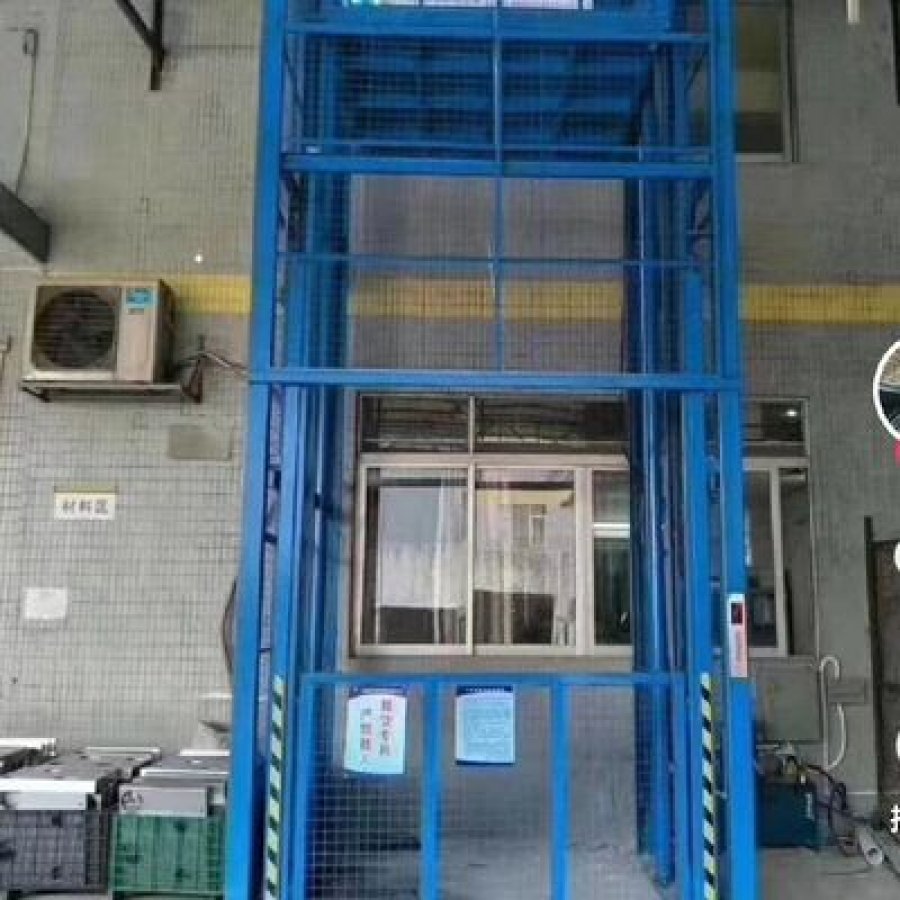
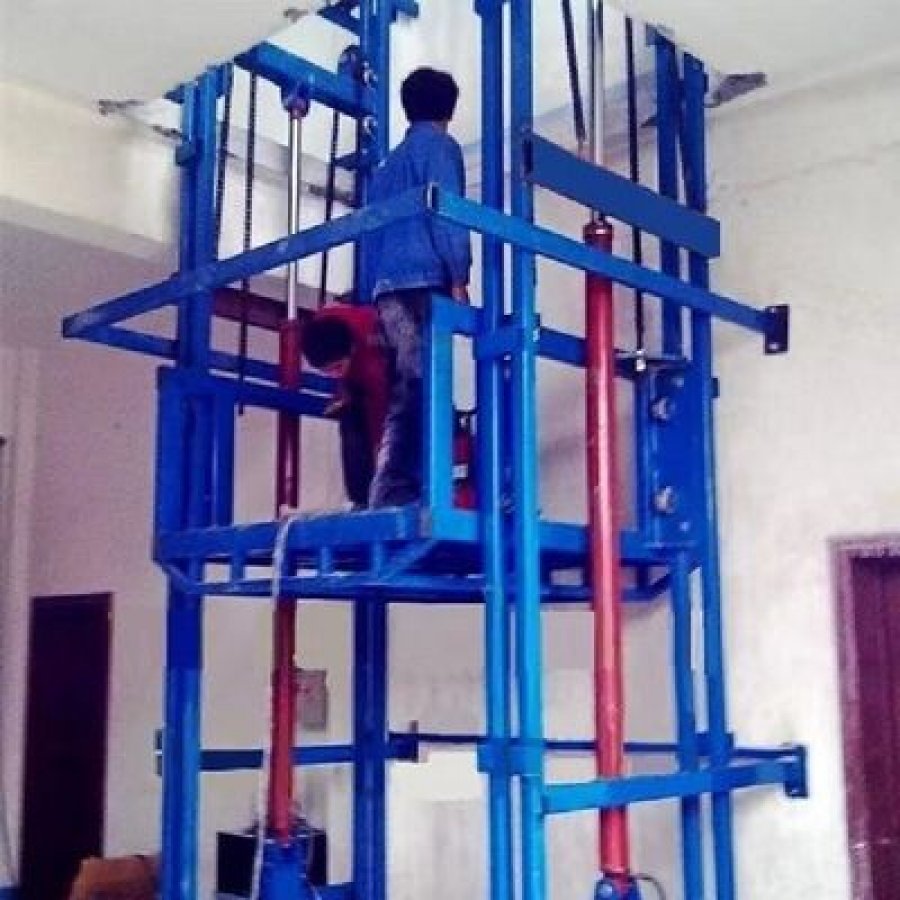
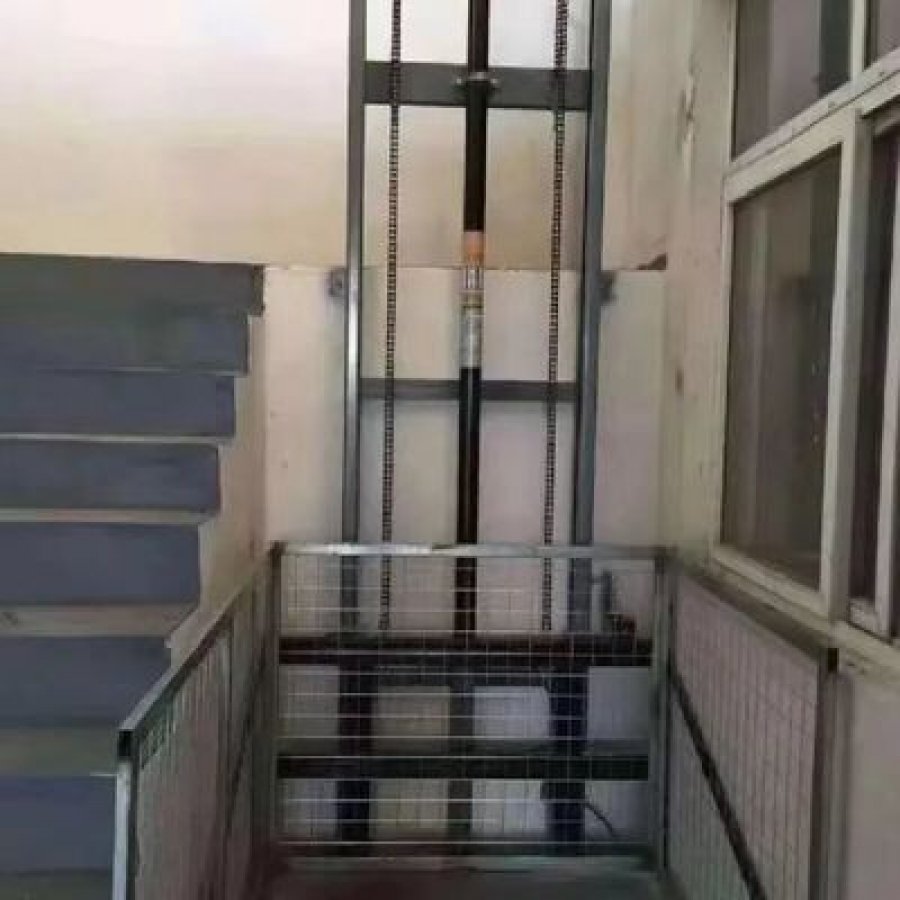
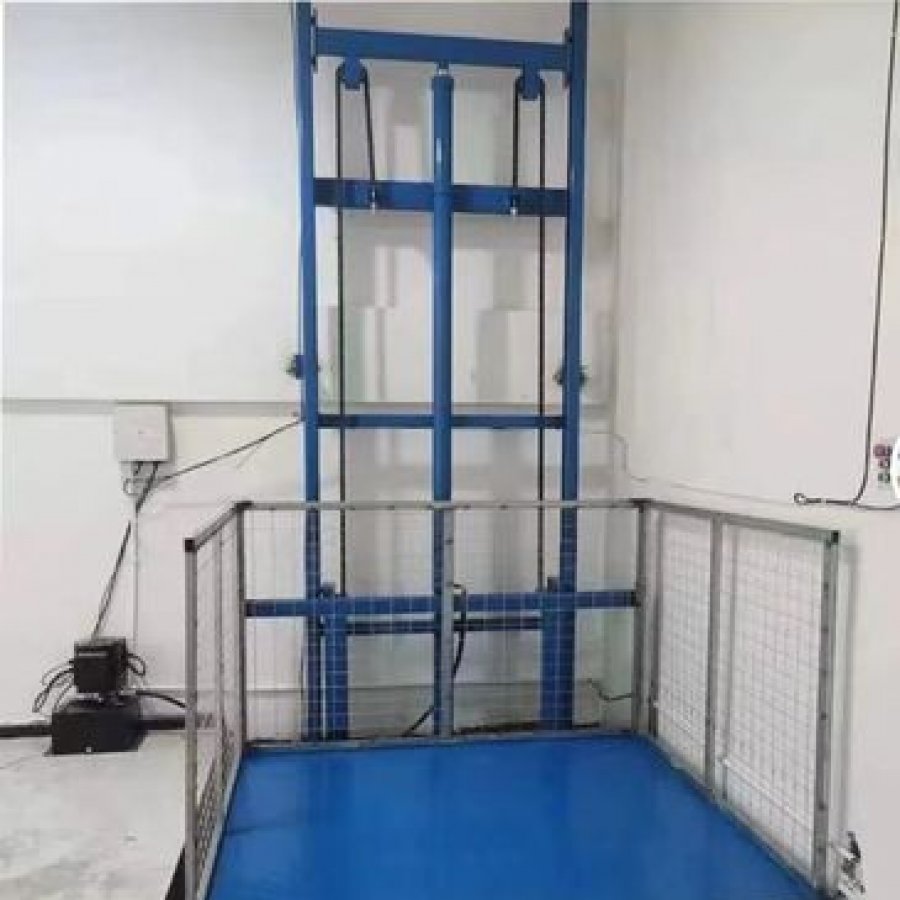
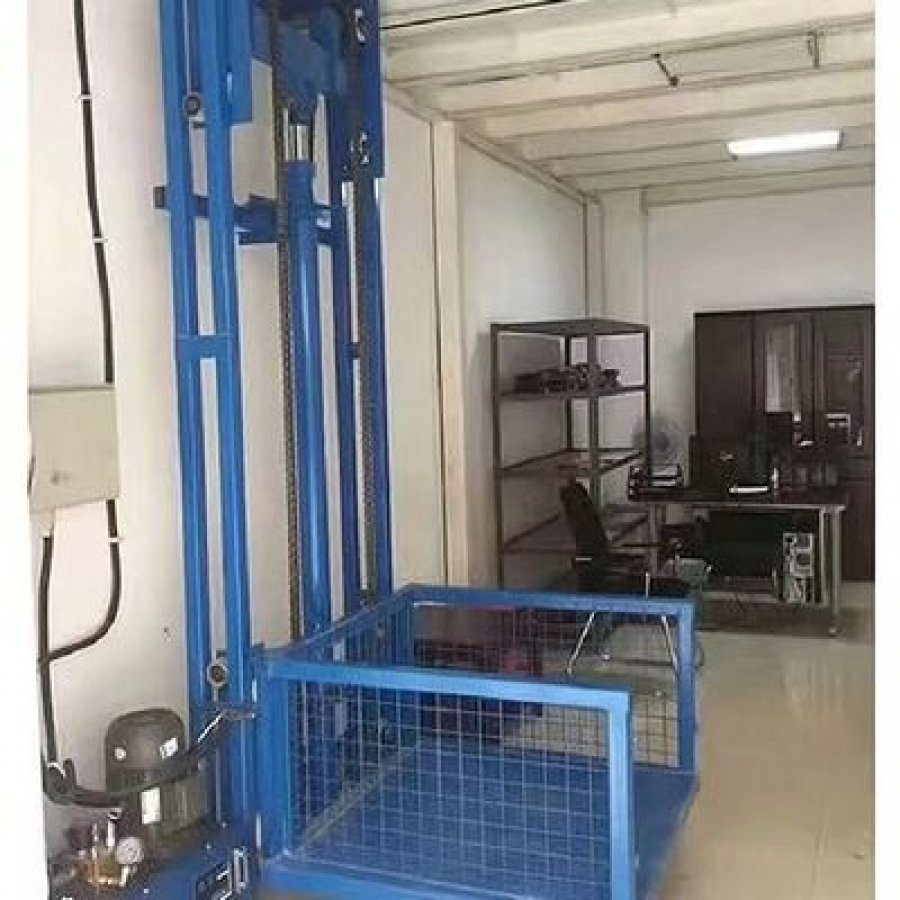
A hydraulic cargo lift has three parts you can point at on site.
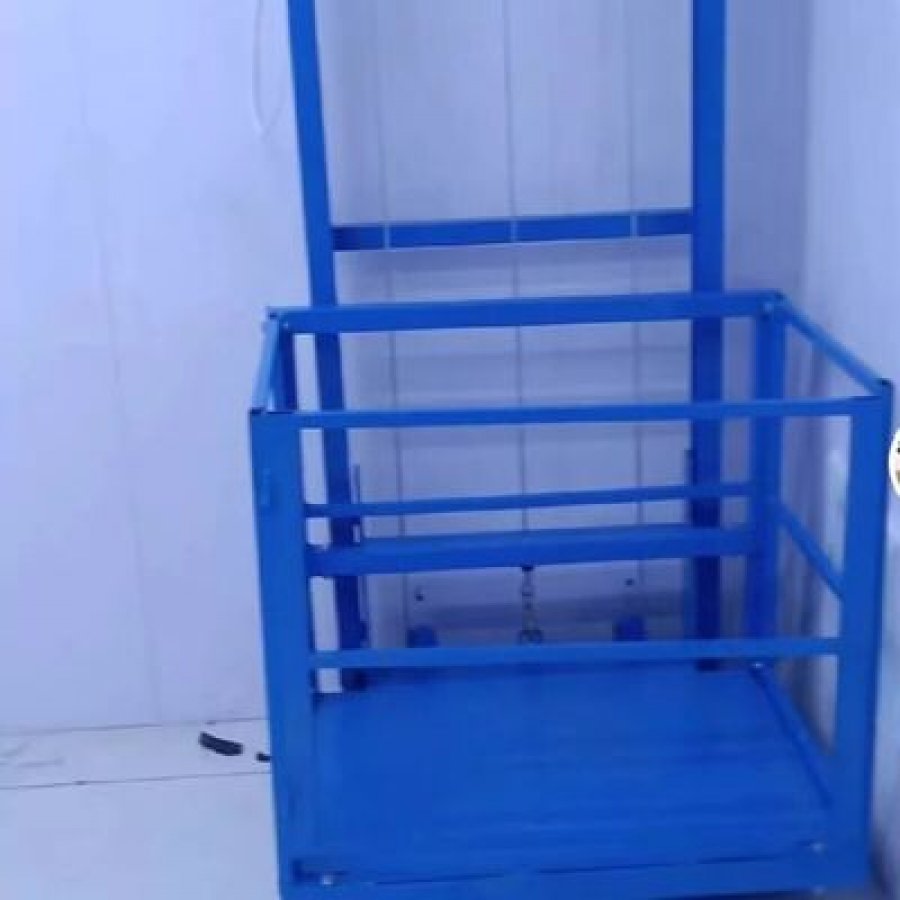
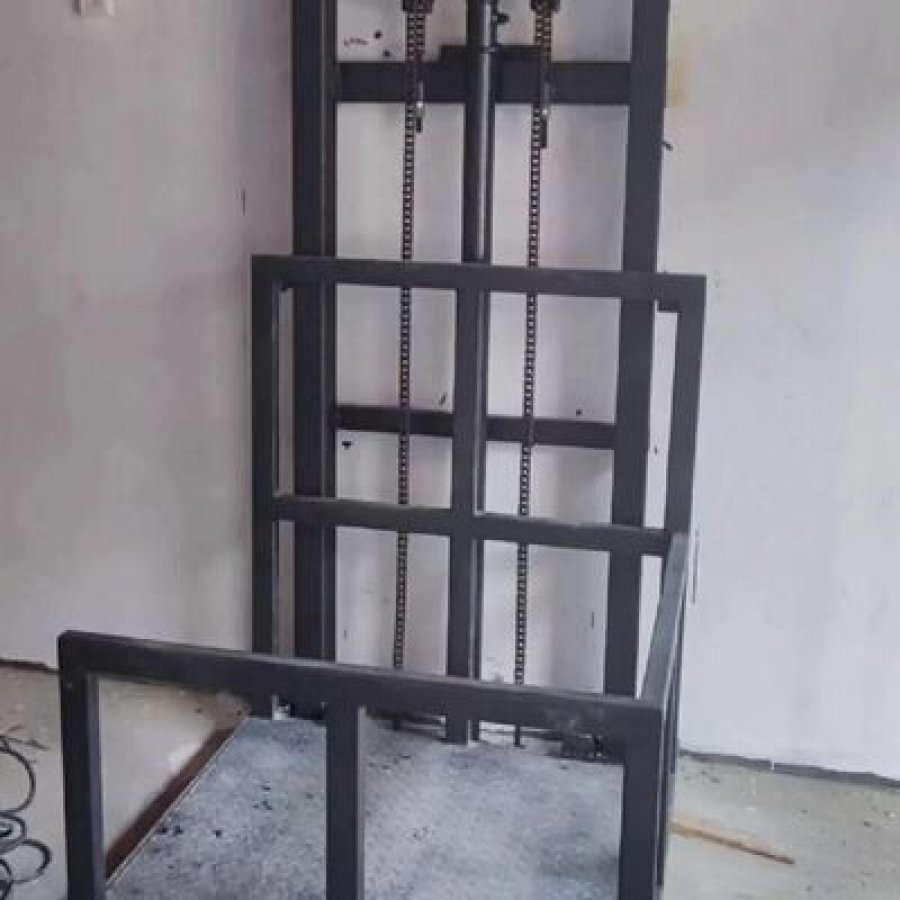
There is a steel platform that carries the load, a guide structure that keeps the platform square as it rises, and a hydraulic power unit that pushes a cylinder instead of winding a rope.
The platform is the working surface. The structure is what the platform slides on.
The power unit sits outside the travel path, normally on the lowest level, and connects to the platform through the cylinder and a short run of hydraulic pipe.
Read the detail: why this layout matters to the building
That layout is why this machine is common in warehouses, workshops and shops where a mezzanine has to be fed from the ground floor, and why it is also awkward in buildings that were never designed for it.
Hydraulic drive puts the heavy part of the system at the bottom of the travel, which keeps the headroom at the top landing low.
It also concentrates load on the floor below the unit, which is the part of the building most people forget to check.
Use the three cards below as a first filter.
Each one lists conditions we can verify from a photograph and three numbers, so you can rule yourself in or out before anyone spends time on drawings.
Good match
Goods travel between floors without people riding on the platform. The load is placed on the deck by a pallet truck, a forklift, a trolley or by hand. You need 1–2 tons of lifting capacity, 1–12 m of travel, and you have 3-phase 380 V power available at the panel position.
Needs confirmation
The floor slab under the unit is a suspended slab rather than ground-bearing concrete. The top landing sits directly above a working area. The platform has to be loaded by a forklift whose wheels concentrate the load into two small contact patches. Each of these is workable, but the drawings change, so raise it early.
Not this product
People are expected to ride on the platform. The building needs a passenger lift with the matching enclosure, doors and code compliance. This page describes a goods-handling machine only, and the panel, gates and platform in the drawings are built for cargo.
One rule we will not bend: if the lift will carry people, tell us on the first enquiry. That single answer changes the product, the paperwork and the price, and no site survey can fix a machine that was chosen for the wrong duty.
If you want to see where this model sits next to the rest of the range, the hydraulic cargo elevator range shows the heavier and lighter sisters of this unit.
It is the fastest way to check whether 1–2 tons is really your bracket.
How a hydraulic cargo lift works
The sequence is short enough to describe in one breath. Every cycle follows the same four moves, and the panel decides all of them.
- 1CallThe operator presses a call button on the landing.
- 2Interlock checkThe Programmable Logic Controller. A small industrial computer that reads the buttons of the lift and switches the motor, valves and door interlocks in a fixed order, instead of relying on relay logic. reads the gate state, the overload device and the emergency stop, then starts the The hydraulic power unit is the tank, motor, pump and valve block that pressurises oil and sends it to the cylinder. It is usually set on the floor beside the guide structure..
- 3LiftThe pump pushes oil into the cylinder, the piston extends, and the platform rises along its guides.
- 4LowerThe PLC opens the release valve and lets oil flow back to the tank under control.
Every stop is decided by position signals, not by the motor running for a fixed time.
What each part does to your site
- The platform is built as a custom steel deck, so its size follows your load rather than a catalogue page. A longer deck means more load spread over more floor area, and also more space that has to stay clear at every landing.
- The guide structure carries the horizontal forces that appear when a heavy load is pushed on or pulled off the deck. That is why the anchors into the floor and the wall behind the structure matter as much as the capacity figure.
- Cylinder: this is the part that does the lifting. It sits below the platform in a pit-mounted arrangement; in a surface-mounted arrangement the drawing changes and the cylinder position follows the frame. Both are described in section 6.
- Power unit: a tank, a motor, a pump and a valve block in one housing. It needs a level, dry position within pipe reach of the cylinder, and it is the part that makes the noise you hear when the lift runs.
- The PLC panel holds the logic that allows a start only when the interlocks are closed, stops the platform at the right level, and shows a fault code instead of a dead machine when something is out of order.
Read the detail: where the failures actually come from
None of these parts is complicated on its own.
The failures we see come from the interfaces: a platform that arrives before the floor is ready, a power unit placed where it gets wet, a panel fed from a circuit that is also running a welder. Section 5 and section 8 cover those points in detail.
Why hydraulic drive suits a goods platform
Goods lifts are built around three drive principles, and each one carries a different set of consequences into the building.
- Hydraulic. A cylinder is pushed by oil pressure, so the drive machinery sits at the bottom of the travel.
- Screw. A nut turns along a threaded shaft, which keeps the mechanism compact but limits the loads and rises a screw lift is normally specified for.
- Traction. Ropes run over a machine, which is how passenger lifts travel so far and so fast, and which brings a machine room or a machine space and heavier overhead structure with it.
For a 1–2 ton platform moving between floors in a warehouse or a stockroom, the practical advantage of the hydraulic route is where the hardware sits.
The heavy parts stay low, the top landing needs less structure above it, and the machine is not sensitive to the exact position of a machine space.
The trade is that oil has to be kept clean and dry, and that the load path ends in the floor under the unit rather than in the building above it.
Load and platform: what 1–2 tons really means
This lift is rated from 1 to 2 tons, which is 1,000 to 2,000 kg of load on the deck. That number is a maximum, not a target, and it applies to a load that is evenly spread.
Read the detail: how the load arrives and where it sits
Two things change the picture in practice, and both are visible on the first photograph you send us.
The first is the way the load arrives.
A pallet set down by a pallet truck touches the deck over a large area.
The same pallet carried in on a forklift is first held by two forks and two wheels, and the steel deck sees load concentrated in small patches.
Neither method is wrong; they need different deck construction, and the difference belongs in the enquiry, not in the installation week.
The second is where the load sits once it is on the deck.
Goods stacked against one edge of the platform put a load on the guides that the capacity figure does not describe.
If your operation always loads from the same side, or always places a machine on the same half of the deck, say so and the platform and the structure can be laid out for it.
1Pallet or stillage
The most common case. Loaded by pallet truck or by hand, then lifted between floors. Deck sized so the pallet sits fully on the platform with a small margin, and the landing threshold sits flush with the deck when the lift is parked.
Tell us: pallet footprint, weight per pallet, and whether the pallet truck goes on the deck.
2Forklift loading
The open side of the platform is approached by a forklift, so the deck and the guide structure are designed for wheel loads. This is also the case that most often pushes a project from ground floor to upper floor, because the forklift needs space in front of the gate.
Tell us: forklift weight, wheel load, and the turning space in front of the platform.
3Long or awkward items
Tubes, profiles, panels and machines that overhang the deck need more thought than a pallet. The load has to be restrained, the deck may need to be longer than the item, and the gate opening has to clear the diagonal of the load when it is moved on.
Tell us: length, weight and how the item is moved at both landings.
Choosing between a 1 ton and a 2 ton cargo lift
Most buyers start by picking the capacity they think they need and finish by picking the capacity that covers their heaviest realistic load plus a margin.
A useful way to reach the number is to write down the three heaviest things the lift will move in an ordinary month, add the weight of the container or pallet, and take the worst case.
If the worst case is inside 1 ton, a 2 ton machine buys margin rather than necessity.
It also costs more, needs a heavier structure and a bigger power unit, and in a mezzanine installation it puts more load on the slab.
| Loading method | What the deck sees | What has to be checked on site |
|---|---|---|
| Hand loading, trolley | Even, low point loads | Operator access, gate opening width |
| Pallet truck on the deck | Wheel loads along two lines | Threshold height, a flat run-up, deck edge strength |
| Forklift placing the load | Concentrated wheel loads on the deck edge | Forklift approach space, deck reinforcement, gate clearance |
| Fixed machine on a stillage | Constant load, often off-centre | Load position on the deck, restraint points for transport |
The platform itself is a custom steel deck, so there is no standard size to argue about.
What we need is the footprint of your largest load, the direction it comes on and off, and the clear width of the opening it has to pass through.
From those three answers we can size the deck, place it in the travel path and tell you what the landing openings have to be — before the quotation, not after the concrete.
Four duties this machine was built for
The same 1–2 ton platform shows up in four settings again and again, and each one asks a slightly different question of the machine.
Reading the four descriptions below is a quick way to recognise your own project, and to see which number you will be asked for first.
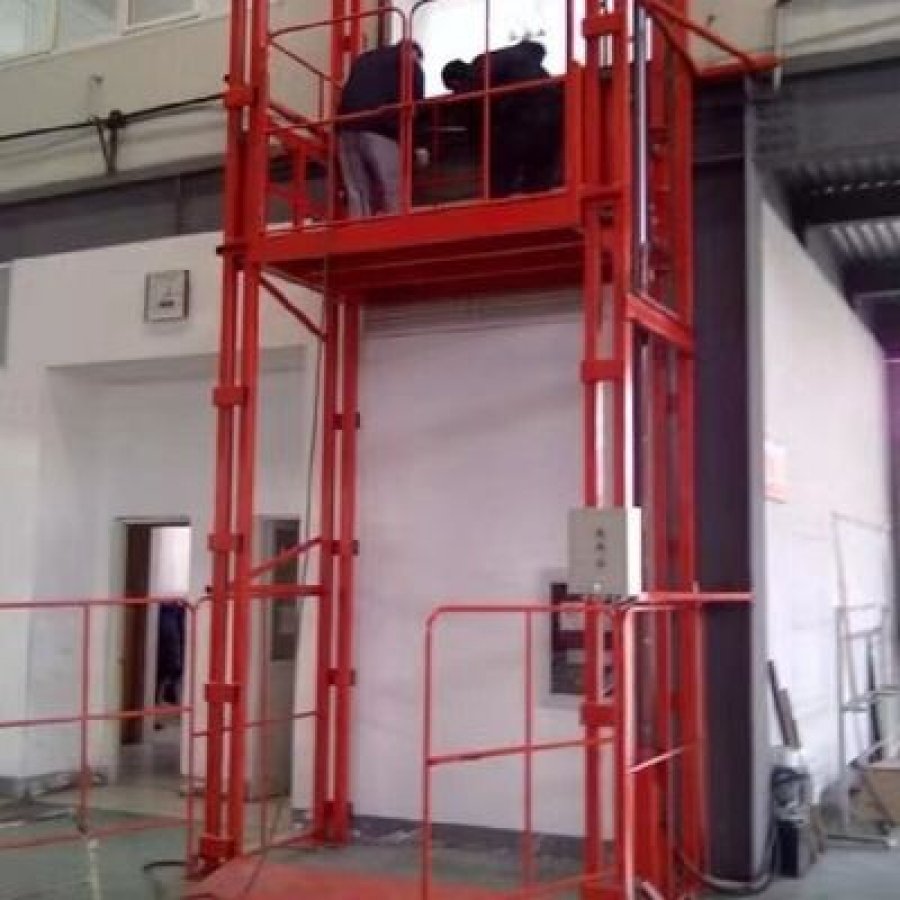
A warehouse cargo lift feeding a mezzanine
Pallets arrive on the ground floor, travel up one level and get stored. The lift runs many cycles a day, the deck is loaded by a pallet truck, and the platform usually parks flush with the mezzanine floor so the truck rolls straight on. The numbers that decide the design here are the pallet footprint, the weight per pallet and the number of cycles per hour.
Watch for: a mezzanine edge that cannot take a concentrated wheel load, and a run-up that is shorter than the loaded pallet truck needs.
A mezzanine cargo lift inside a shop or stockroom
Space is the constraint, not speed. The lift is tucked into a stockroom corner and lifts boxes, drums or retail stock to a sales floor above. Deeper widths are rarely available, so the deck is built narrow and long, and the gate arrangement at the upper landing has to work in a corridor.
Watch for: headroom above the top landing, and the swing of the gate where the corridor is narrow.
A 2 ton cargo lift for machines and parts
The heavy end of the range, where the load is a machine, a mould, a pallet of steel or a stillage that never changes weight. Cycles are few, but each one is critical, and the load is often placed by forklift. A 2 ton cargo lift in this duty is chosen for margin rather than for daily throughput.
Watch for: off-centre loading, and the height of the machine plus its transport frame against the travel you have measured.
Materials on site during construction or fit-out
Temporary or semi-permanent duty: boards, profiles, tiles and tools going up one or two levels while a building is finished. The lift stays installed afterwards, so the question to answer at the start is whether the unit is meant for the fit-out period only or for production use afterwards — the answer changes the deck and the anchoring.
Watch for: dusty environments, and a power supply that is a temporary distribution board rather than a permanent one.
Two of those four duties are worth separating in your own mind before you write to us.
Pallets and stock move on a rhythm: many cycles, moderate weight, and the machine lives or dies on the loading edge and the gate.
Machines and moulds move occasionally: few cycles, heavy load, and the machine lives or dies on the deck construction and the floor below it.
Tell us which rhythm your site runs and the specification conversation gets much shorter.
Height and speed: 1–12 m, 0.05–0.2 m/s
Lifting height for this unit runs from 1 m to 12 m, and lifting speed from 0.05 m/s to 0.2 m/s.
Both are chosen inside those bands rather than fixed by the model, and both are decided by the same two inputs: how far the platform has to travel, and what happens at each landing.
Height is measured as travel between the lowest and the highest landing, not as the height of the building. A single-storey mezzanine is often 3–4 m of travel.
A two-level warehouse racking mezzanine with a loading bay beneath can reach 6 m or more.
At the top of the range, 12 m of travel means the guide structure is a substantial structure in its own right, and the position of the top landing starts to govern the whole layout.
Speed is a compromise you will feel every day. A 0.2 m/s platform covers 6 m of travel in roughly 30 seconds of moving time, before you count the door sequence at each end.
At 0.05 m/s the same 6 m takes about two minutes in motion.
Choose the fast end of the band when the lift runs many cycles an hour and can be loaded quickly.
Choose the slow end when it runs a few times a day, where a soft, quiet start and stop is worth more than a short cycle.
| If the travel stays short | If the travel goes long |
|---|---|
| Guide structure stays light, and the installation stays simple. | The guide structure becomes the dominant part of the drawing, and it has to be anchored top and bottom. |
| The top landing needs less structure above it. | The position of the top landing starts to govern the whole layout. |
| Alignment is easy to hold over a short run. | The platform has to hold its alignment over the full run. |
What the travel figure changes
Short travel keeps the structure light and the installation simple. Long travel makes the guide structure the dominant part of the drawing: it has to stay straight, it has to be anchored top and bottom, and the platform has to hold its alignment over the full run.
What the speed figure changes
Higher speed needs a larger motor and pump, which draws more current and adds noise. Lower speed needs less of both. Neither affects the 1–2 ton capacity band, so speed is a comfort and cycle-time decision, not a capacity decision.
Worked example, not a promise of cycle time: a 6 m travel at 0.1 m/s is about 60 seconds of motion. Add the time for the interlock to release, the gate to be opened, the load to be moved on or off, and the gate to be closed again. That total, not the 60 seconds, is what your operator experiences.
Cycle-time estimator
Move the two sliders to see how travel and speed change the time the platform spends moving. The sliders are limited to the documented bands.
Formula: motion time = travel / speed. Reference only — it counts the platform moving, not the interlock release, the gate, or loading and unloading. Final engineering verification required.
Two habits save money at this stage.
- Measure the travel you actually need. A lift that goes 200 mm above the top floor slab costs more in structure than one that stops level with it.
- Decide the lowest landing early. Ground level or a sunken slab is the difference between the pit and no-pit arrangements in the next section.
Power and control: 380 V, three phase, PLC panel
This hydraulic cargo lift runs on a 3-phase 380 V 50 Hz supply and is controlled from a PLC panel.
Those two facts decide most of the electrical work on your side, so they are worth reading before an electrician quotes for the job.
The short version: if the site cannot provide three-phase 380 V at the panel position, this is the wrong machine, and no quotation will fix that.
Three-phase power is not a preference here, it is what the power unit is built for. The motor that drives the pump needs the starting torque and the current behaviour of a three-phase supply.
If your building only has a single-phase service, this model is not the machine to force onto it.
The honest answer is either to bring three-phase power to the panel position or to review a different lifting solution with us.
Tell us what you have at the panel position and we will say which of the two applies instead of quoting around the problem.
380 V three phase available
A three-phase distribution board is within cable reach of the unit, or the service can be extended to it. The supply is dedicated to the lift, or can be made dedicated so that welding equipment and compressors do not share the circuit.
Three phase available, but far away
The panel can still be fed, but the cable run, the protective device in the board and the point where the cable enters the panel all have to be agreed. Send the distance and we will mark the required supply point clearly on the drawing.
Single phase only
The machine is built for a 380 V three-phase supply. Before ordering, either arrange the supply or let us review the duty with you. Do not buy this unit hoping to convert it later — motor, pump and control gear are matched as a set.
What the PLC panel does for the operator
- Unsafe starts are refused. The panel reads the gate interlock, the overload device and the emergency stop before it allows the pump to run. If any of them is open, the lift stays still.
- It stops at the right level. Landing positions are set as signals, so the platform parks level with the floor instead of drifting as the machine warms up.
- Faults are reported, not hidden. A fault on the panel replaces guesswork: the maintenance technician starts from a code, not from the beginning.
- It keeps the sequence repeatable. The same start, run, decelerate and park order runs every cycle, cycle after cycle, which is what makes a simple machine reliable in a warehouse.
Two details are easy to settle late and expensive to settle late. The first is where the panel physically goes.
It needs a dry position, enough space in front for a person to open it, and a clear view of the loading edge if the operator works from it.
The second is where the call buttons go at each landing, because that decides the cable routing and the position of the gate.
Both are marked on the approval drawing before production starts, and both become firm once you approve that drawing.
Site electrical work is not in the equipment price unless it is listed in your quotation. Bringing the supply to the panel, the protective device in the distribution board, and the earth connection belong to the site. We mark the position and the requirement; your electrician makes the connection.
Where the panel goes, and what has to be ready round it
Read the detail: where the panel goes and what has to be ready round it
Treat the panel position as a small piece of site planning rather than a wall to be found later.
It needs a dry surface at a height where a person can read the display without a ladder.
Leave roughly a metre of clear space in front of the door so it can be opened fully, and route the cable back to the distribution board away from wash-down areas and welding circuits.
If the panel doubles as the operator station, position it with a line of sight to the loading edge.
If it is purely a maintenance point, put it somewhere a technician can work without stopping the rest of the building.
Getting this right at the drawing stage costs nothing.
Moving a panel after the cable has been run, and after the gate positions have been fixed, costs a day of site work and a new length of cable.
Pit or no pit: two ways to mount the platform
This unit can be installed with a pit or mounted on the finished floor without one.
The difference is more than a hole in the ground: it changes the cylinder arrangement, the height of the lowest landing, the shape of the loading threshold and the way the floor carries the load.
The short version: a pit gives you a flush floor at the lowest landing, which is what a loaded pallet truck wants; the surface-mounted version avoids excavation altogether and is usually the practical choice for a retrofit.
| Point | Pit mounted | Surface mounted, no pit |
|---|---|---|
| Lowest landing | Deck parks flush with the finished floor | Deck sits above the floor, reached by a ramp or threshold |
| Civil work | Excavation, formwork and drainage around the pit | No excavation; the floor takes the load through a base frame |
| Loading with a pallet truck | Easiest: the wheels roll on at floor level | Needs a ramp you can roll a loaded truck up |
| Water and cleaning | Pit must be kept dry; drainage has to be planned | Nothing below floor level to fill with water |
| Retrofit into an existing building | Possible, but cutting a slab is a real cost | Usually the practical choice |
| Headroom at the top landing | Set by the structure and the load height | Set the same way, plus the height of the raised deck at the low landing |
What the floor has to do
Both arrangements put the load into the floor at a small number of points: the base of the guide structure, and the area under the cylinder or power unit.
Read the detail: what the floor has to do, and who checks it
A ground-bearing slab and a suspended slab behave differently under that load, and a suspended slab has to be assessed rather than assumed.
We are not your structural engineer, and this page will not pretend to replace one.
What we do is mark the load points and the approximate load at each point on the approval drawing, so the right person on your side can check the slab before anything is delivered.
Three site details decide whether the installation week runs smoothly.
- Keep the power unit dry. A hydraulic unit standing in water is a fault waiting to happen.
- Give the loading edge a flat, even approach. A step at the threshold is what tips a loaded pallet truck.
- Leave the cable route open. That route is often the last thing to be finished and the first thing to stop commissioning.
Safety devices and interlocks
This cargo lift is delivered with a safety interlock, overload protection and an emergency stop button.
Those three devices are listed in the specification, and they are worth understanding as a set, because together they define the boundary between a machine that stops when something is wrong and a machine that keeps going.
- Safety interlock. The gate or door at a landing cannot be left open while the platform is somewhere else, and the platform cannot be moved while an access point is open. The PLC reads that state first in every cycle, which is why the interlocks appear at the top of this list.
- Overload protection. If the load exceeds what the machine is set for, the lift does not lift it. That protects the structure and the cylinder, and it also protects the habit of adding “one more box” to a full deck.
- Emergency stop button. A hard stop that cuts the movement and holds the platform, so an operator standing next to an unexpected movement has one action to take, not a sequence to remember.
- Walk your own installation through these three questions0 / 3
Beyond the three built-in devices, the safety of a goods lift is decided by the way it is used.
- Keep the deck clear of loose material that can fall through the gap at a landing.
- Keep the area in front of the loading edge free of the things that get parked there during busy weeks.
- Put the person who operates the lift most often in contact with whoever services it, so that a change in noise or a slower stop is reported rather than tolerated.
If your team is new to powered lifting equipment, our article on strategies to improve freight elevator safety covers the operating habits around a lift of this type.
It is a reasonable basis for a short toolbox talk before the machine is handed over.
From enquiry to running lift: the sequence
An order for a hydraulic cargo lift is not complicated, but it has eight steps, and each one needs something from you before the next can start.
The timeline below is the order we follow. Where a step needs input from your side, it is written under the step.
-
1
Requirement and site facts
You send the load, the travel, the landing arrangement and the power supply you can provide. We confirm whether this model fits and what else is needed.
You provide: load weight and footprint, travel height, number of landings, supply available at the panel position.
-
2
Technical review and quotation
We check the duty against the machine, set the platform size, choose the speed inside the 0.05–0.2 m/s band and price the equipment with the terms that apply to your destination.
You provide: destination port or city, and any drawing or photograph of the opening that already exists.
-
3
Approval drawing
Before production, you receive the arrangement drawing: platform size, travel, mounting method, the load points to be checked on your slab, and the electrical supply position marked on the plan.
You provide: written approval, or the corrections that have to be made first.
-
4
Production
The platform, guide structure, cylinder and power unit are built to the approved drawing. Production planning starts from the date the drawing is approved.
You provide: confirmation of the delivery address and the contact who will receive the shipment.
-
5
Pre-shipment check
The unit is assembled and run before packing, so that the stop positions and the panel sequence are verified on the machine rather than on paper.
You provide: any special inspection requirement you have, agreed before production finishes.
-
6
Packing and shipment
Equipment travels in an export non-fumigation wood box. Standard terms are T/T or L/C, with delivery time stated in your quotation.
You provide: the port, the agent contact, and confirmation of who clears the goods at destination.
-
7
Site preparation
The floor is checked against the load points on the drawing, the opening is prepared, and the electrical supply is brought to the panel position with the protective device in place.
You provide: the site work listed in your quotation, plus the cable and the earth connection.
-
8
Installation and commissioning
The unit is set, levelled, anchored, connected and run through its stops with a load on the deck.
Training for the operators is best done at this moment, while the machine is still new to everyone.
You provide: access to the site, a power supply for commissioning, and the operators who will use the lift.
Two steps in that list cause most of the delay we see: the approval drawing that waits for a reply, and site preparation that starts after the equipment has landed.
Neither is a technical problem. Both are calendar problems, and both are fixed by one person on your side owning those two steps from the start.
Inspection, upkeep and the 12-month warranty
The delivered equipment carries a 12-month warranty.
What that warranty protects is a machine that has been installed to the approved drawing, kept dry, and inspected on a regular basis; it does not replace the checks that belong to everyday operation.
Commissioning checks
At hand-over the machine should be run through its full travel with a representative load on the deck, not empty.
Read the detail: what commissioning verifies
Stop positions, the interlock sequence, the overload device and the emergency stop are all verified at that point, and the people who will use the lift watch the run and ask their questions while the technician is still on site.
If commissioning happens with an empty deck, the first heavy load becomes the test, which is the wrong way round.
What to watch during the first months
- Noise and speed. A power unit that becomes noticeably louder, or a platform that takes longer to reach the top, is reporting something. Both are cheap to investigate early.
- Oil level and leaks. The tank level and the floor under the unit are the two quickest checks on the machine. A dry patch is information, not a stain to clean up and forget.
- Anchors and alignment. The guide structure should be as straight as the day it was anchored. A structure that has moved is often a floor that has moved with it.
- Interlocks and gate hardware. Gates take more wear than any other part of a goods lift, because they are operated by people carrying things.
- Deck surface and edges. A deck that has been dented by a forklift keeps its capacity but loses its flat approach, which is what makes loads walk off a pallet truck.
Keeping the machine serviceable
Three habits keep a hydraulic lift easy to maintain over its working life.
- Keep the area around the power unit clear, so a technician can reach the tank and the valve block without moving stock.
- Leave the pit dry and clean, where there is one, since debris in a pit is what eventually damages a platform edge.
- Keep the drawings where the maintenance team can find them. A machine that has to be identified before it can be serviced always costs more than one that does not.
Parts and support: spares, replacement hydraulic components and control parts are supplied from the same factory that built the unit. Give us the platform size, travel, capacity and the year of delivery from your quotation, and we can identify the machine from our own records rather than asking you to read numbers off a plate in a dark shaft.
Buyer questions before a cargo lift order
These are the questions that arrive with most enquiries for this machine. The answers use the figures on this page; where a question depends on your site, the answer says so instead of guessing.
What does a hydraulic cargo lift of this size cost?
The configuration described on this page is quoted in the terms panel at USD 4,000–10,000 per set, for the equipment. The exact figure inside that band depends on the platform size, the travel and the capacity you choose, plus the destination. Those four answers turn a band into a firm number.
How long does delivery take?
Your quotation states the delivery time for your order. The terms panel on this page shows 20 working days for this configuration, and production is planned from the date the approval drawing is signed off rather than from the date of the enquiry.
What is the minimum order quantity?
One set. This is a built-to-order machine and there is no container-fill requirement to reach before an order can be placed.
Can people ride on this lift?
No. It is a goods-handling machine and it is built, gated and controlled as one. If a passenger lift is what your building needs, say so at the first contact and we will point you to the right product instead of adapting this one.
What electrical supply do I have to provide?
A 3-phase 380 V 50 Hz supply at the panel position, with its own protective device in the distribution board and a proper earth connection. Bringing that supply to the panel is site work, and it is marked on the approval drawing.
How high can it lift?
From 1 m to 12 m of travel, chosen to suit the building. Travel is counted between the lowest and the highest landing, and at the upper end of the range the guide structure becomes the dominant part of the installation.
How fast does it move?
Between 0.05 m/s and 0.2 m/s. Speed is set within that band when the machine is specified. It changes cycle time and noise, not the 1–2 ton capacity.
Does it need a pit?
It can be installed either way. A pit lets the deck park flush with the finished floor, which is the easiest arrangement for a loaded pallet truck. A surface-mounted unit avoids excavation entirely and reaches the deck over a ramp or threshold. Both are shown in section 6.
What has to be checked in my floor slab?
The load points under the guide structure, the cylinder and the power unit, and whether the slab carrying them is ground-bearing or suspended. We mark the points and the approximate load on the approval drawing. The structural assessment is your engineer’s decision, and we would rather hand over the inputs than pretend to make it for you.
Can the platform be made to my own size?
Yes. The platform is a custom steel deck. Send the footprint of your largest load, the direction it comes on and off the deck, and the clear width of the opening at each landing, and the deck is sized around those.
Can it be installed outdoors?
This page does not list an outdoor rating for this model, so we will not claim one here. If the unit is going outside, or into a wet or dusty area, tell us and we will confirm what protection the machine needs for that position before you order.
What warranty comes with it?
Twelve months on the delivered equipment, provided the machine has been installed to the approved drawing and inspected as described in section 9. Commissioning with a representative load on the deck is the point where the warranty period is best started.
Send four answers and we can price your lift
Most enquiries that stall do so because one of the four answers is missing.
Work through the list below before you send it; the count on the right updates as you go, so you can see what is still open.
Nothing is transmitted by this page — it is a preparation list for the message you send us.
- What we need for a firm quotation0 / 11
A photograph of the opening is worth more than a long description.
Take one from the landing, one from the side of the proposed lift position, and one of the floor area where the power unit would stand.
Those three images answer most of the questions above before anyone has to ask them.
If you are still comparing product families rather than a single machine, the product overview lists the other lifting solutions we build.
Use it to check that a goods platform is the right answer for the duty before spending time on dimensions.
Want to Know more details about this product
Similar Products